
A potential customer asks an AI assistant to compare service providers. Another uses an AI-powered search experience to investigate a technical problem.
Does your website provide information that can help answer those questions?
Search visibility now involves more than monitoring a list of keyword positions. Businesses also need to understand whether their content is accessible, clearly explained, accurate, and appearing in relevant AI responses.
This evolving search landscape has increased interest in generative engine optimization and answer engine optimization, which focus on improving content discovery and relevance within AI-generated responses and direct-answer experiences.
An AI readiness audit helps identify technical and content gaps worth investigating. It provides a starting point for improvement, while citation monitoring shows what happens in the AI answers you track.
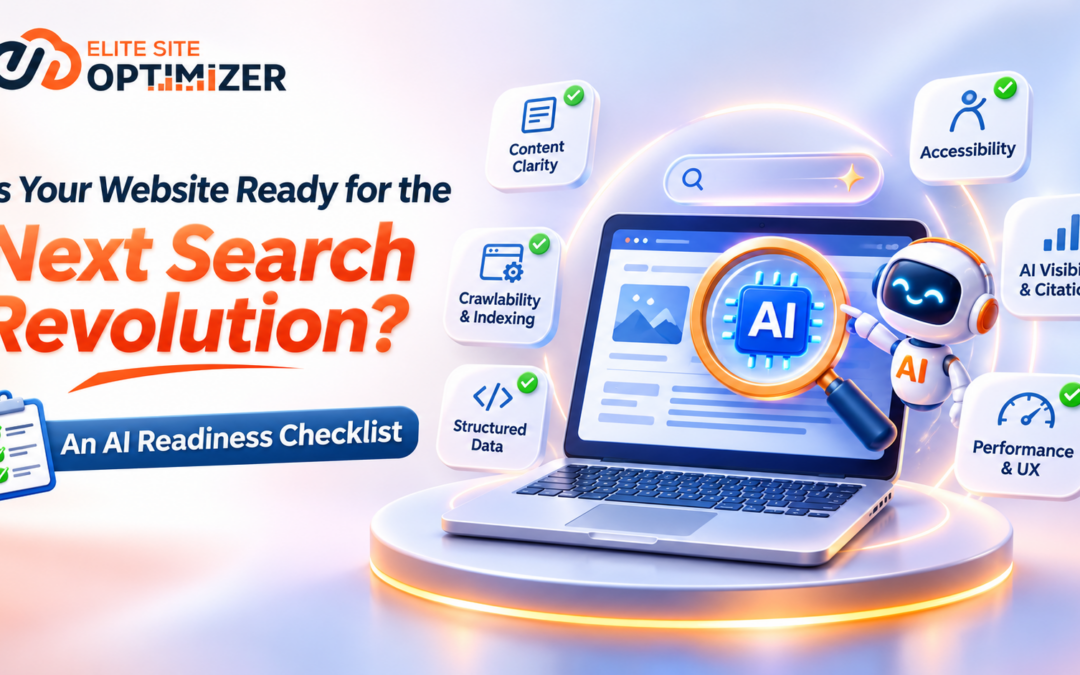
Use this checklist to review your website’s foundations and plan your next steps.
What Does AI Readiness Mean?
AI readiness describes how well your website supports discovery and interpretation by relevant search and AI systems.
It includes familiar website fundamentals: accessible pages, useful content, descriptive headings, reliable information, and appropriate structured data.
These fundamentals also form an important part of artificial intelligence search engine optimization, where businesses consider how their content is discovered and interpreted across evolving search experiences.
Requirements differ across platforms. For Google’s AI Overviews and AI Mode, pages must be indexed and eligible to appear in Search with a snippet. Google Search Central states that there are no additional technical requirements for these features.
An audit can reveal obstacles and improvement opportunities. It cannot guarantee that an AI platform will cite or recommend your business.
1. Check Access to Important Pages
Your content needs to be available to the systems you intend to reach.
Review priority pages such as service descriptions, product information, expert resources, and company details. Look for accidental restrictions or technical failures.
Checklist:
- Important URLs load successfully.
- Robots.txt rules reflect your intended access policy.
- Relevant pages are not unintentionally marked no index.
- Hosting or security settings do not accidentally block intended crawlers.
- Sitemap entries point to current, useful URLs.
Different crawlers serve different purposes. Review platform-specific guidance before changing access rules, rather than assuming every bot should receive identical permissions.
For example, Open AI’s crawler documentation explains the different purposes of its web crawlers and how website owners can manage their access.
2. Confirm That Essential Content Renders Reliably
A page can look complete in your browser while depending on scripts or interactions that complicate automated access.
Check whether essential descriptions, specifications, and links appear reliably. Investigate failed requests and JavaScript errors affecting important content.
Checklist:
- Key information is available as text.
- Content does not depend solely on an image.
- Important details do not appear only after complex interactions.
- Relevant links exist in a usable form.
- Rendered output contains the information visitors need.
Google’s JavaScript SEO documentation provides additional guidance on how search systems process and render JavaScript-powered websites.
ESO’s AI Readiness Audit includes page rendering checks alongside crawlability, semantic structure, content clarity, and structured data analysis.
3. Give Each Page a Clear Purpose
A service page should explain the service. A comparison should help readers understand meaningful differences. A troubleshooting guide should help them investigate a problem.
When a page tries to cover everything, its main purpose can become difficult to identify.
Checklist:
- The title accurately describes the topic.
- The opening explains who the page helps.
- Headings organize the information logically.
- Each section contributes to the main question.
- Important terminology is explained.
For example, a page about accessibility audits should clearly describe the assessment scope, deliverables, limitations, and next steps.
4. Answer Customer Questions Directly
Review the questions people ask during sales conversations, demonstrations, and support interactions.
These can reveal information missing from your website.
Checklist:
- Explain what the product or service does.
- State who it is designed for.
- Describe relevant requirements and limitations.
- Clarify implementation or delivery steps.
- Explain what happens after an enquiry or signup.
Use question headings when they help readers. Avoid adding repetitive FAQ sections simply to increase page length.
Clear answers improve the page’s usefulness. Their presence does not establish eligibility for a particular AI citation.
5. Add Evidence Your Team Can Support
Generic claims give readers little basis for evaluating your expertise.
Replace vague statements with relevant examples, documented processes, original findings, or clearly explained experience.
Checklist:
- Statistics have identifiable sources.
- Case studies explain their scope and context.
- Product claims match current capabilities.
- Expert contributions are accurately attributed.
- Limitations are stated where they matter.
- Dates are updated when the underlying information changes.
Never invent research, testimonials, or performance figures to make a page appear more authoritative.
Google’s guidance on creating helpful, reliable, people-first content offers additional recommendations for developing trustworthy and useful website information.
6. Review Structured Data for Accuracy
Structured data provides explicit descriptions of page content and entities. Its usefulness depends on choosing appropriate types and supplying accurate information.
Checklist:
- Markup describes the actual page.
- Business and author information is consistent.
- Product or offer details are current.
- Multiple scripts do not publish conflicting values.
- Validation findings are investigated.
The Schema.org vocabulary provides standardized structured data types and properties that businesses can use to describe their website content accurately.
ESO’s Schema Analysis is a relevant part of the broader review workflow.
Avoid treating special markup or an AI text file as a universal requirement. Google explicitly says that new AI files and special Schema.org markup are unnecessary for its AI search features.
7. Make Your Business Easy to Identify
Visitors should be able to understand who publishes the content and what the organization offers.
Review company names, product relationships, contact details, and author information across important pages.
Checklist:
- Your About page describes the organization clearly.
- Product names and descriptions are consistent.
- Contact details are accurate.
- Relevant author biographies explain their expertise.
- External business profiles contain current information.
This supports a coherent public presence and helps people verify your business. It is not a formula that guarantees AI recommendations.
8. Strengthen Navigation and the Visitor Experience
Useful content should be easy to reach and act on.
Review internal links between related articles, service pages, and product resources. Check that navigation labels explain their destinations and that important links work.
Also test the experience after arrival: can visitors read the content, use the controls, and complete the next step?
Checklist:
- Related pages link to each other appropriately.
- Important resources are not isolated.
- Broken links are corrected.
- Mobile layouts remain usable.
- Forms and controls support accessible interaction.
- Performance problems do not obstruct key tasks.
The Web Content Accessibility Guidelines (WCAG) provide an established framework for making digital content more accessible to people with disabilities.
These improvements support the people who arrive through any channel.
9. Measure AI Visibility Separately From Readiness
A technically healthy website may still be absent from the answers you monitor. A citation may appear without generating a visit.
Using AI SEO tools can help businesses organize technical audit findings and monitor their presence across supported AI-powered search experiences.
Keep these observations separate.
| Measurement | What it tells you |
| Audit finding | An identified technical or content issue |
| Readiness score | A tool’s summary of its selected checks |
| Brand mention | The business appears in a monitored answer |
| Linked citation | The answer references a website URL |
| Identifiable referral | A measurable visit arrives from an AI platform |
| Conversion | A visitor completes a defined action |
ESO’s AI tools include citation and brand mention monitoring across supported experiences on ChatGPT, Gemini, Claude, and Perplexity.
Record the questions, platform, date, and relevant settings when reviewing results. Responses can vary, so one answer should not represent your entire AI search presence.
Turn Your AI Readiness Audit Into an Action Plan
Begin with your most important pages and record a baseline. Group findings by impact, assign responsibility, and verify changes after implementation.
Prioritize access failures and missing essential content before minor editorial adjustments. Then improve explanations, evidence, navigation, and data consistency.
For businesses adopting AI for SEO, combining automated analysis with human review can support a more structured and informed website optimization strategy.
Elite Site Optimizer brings readiness checks and AI visibility monitoring into the same platform, helping teams investigate both website gaps and observed answer presence.
Use those findings to guide work, and use traffic and business outcomes to evaluate its value.
Start with Elite Site Optimizer’s AI Readiness Audit to identify the technical and content improvements your website needs next.
Ready to improve your website’s search performance?
Sign up for Elite Site Optimizer and start analyzing your website’s SEO, accessibility, performance and content quality.
Start Your Free Signup