
Page Index Report
Understand how your crawl, sitemap, and index counts compare
The ESO Page Index Report brings several page-discovery and indexing signals together. It can show the number of pages crawled by ESO, pages reported as indexed by Google, URLs listed in the sitemap, pages returning 4xx or 5xx errors, and pages marked with a `noindex` directive.
Use the counts to spot differences that may deserve investigation—for example, sitemap URLs that return errors or pages that are marked `noindex`. The report is a high-level comparison, not a URL-by-URL guarantee of Google’s current index state.
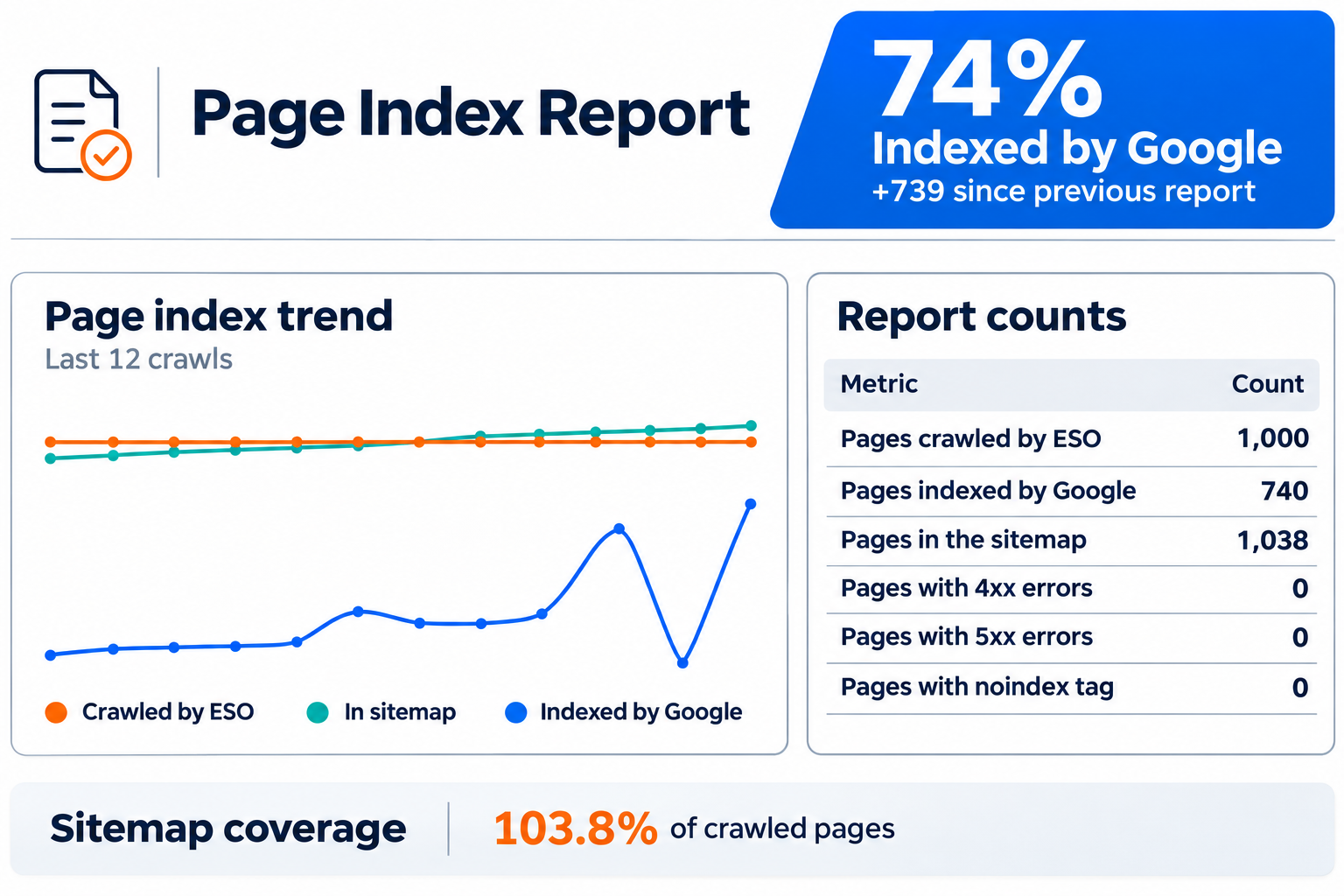
Signals included in the report
– Pages crawled by ESO: URLs discovered and processed by the ESO crawl used for the report.
– Pages indexed by Google: An index-count signal collected for the report. It may not represent a complete or real-time list of indexed URLs.
– Pages in the sitemap: URLs found in the sitemap data used by the report.
– 4xx pages: Pages with client-error HTTP status codes in the crawl data.
– 5xx pages: Pages with server-error HTTP status codes in the crawl data.
– Pages with `noindex`: Pages where the crawl detected a `noindex` directive.
Where historical results are available, the report can chart these counts across crawls to help you compare changes over time.
Use the report to guide an investigation
Review crawl details
Review the report date and the crawl it is based on.
Compare indexing signals
Compare crawled pages with sitemap and index-count signals.
Investigate page issues
Investigate 4xx/5xx URLs and noindex pages in the relevant reports or Search Console.
Verify exclusions and errors
Confirm whether each exclusion or error is intentional.
Monitor crawl changes
Re-run or review the next completed crawl to check for changes.
Index counts need context
Search engines control their own indexing systems. Google’s index count can change, may be approximate, and may not correspond exactly to the URLs in a site’s sitemap or ESO crawl. A URL may be crawled but not indexed, indexed without appearing in a current crawl, or intentionally excluded.
Page Index data
Page Index data may be generated after the main crawl and can take additional time to appear. If the report is still being generated or a metric is unavailable, check its report status and try again later rather than interpreting a missing value as zero.
Frequently asked questions
Does the Page Index Report list every URL indexed by Google?
No. It reports an index-count signal alongside ESO crawl and sitemap counts. It should not be treated as a definitive URL-by-URL inventory of Google’s index.
Why can the Google indexed-page count differ from my sitemap count?
The sitemap lists URLs submitted or declared by the site, while search engines decide which URLs to crawl and index. These counts can differ for many reasons, including redirects, duplicates, crawl access, canonicalization, `noindex` directives, and changes over time.
Does a `noindex` page always indicate a problem?
No. Some pages are intentionally excluded from search results. Check the page’s purpose and indexing policy before changing the directive.
Why is Page Index data missing or still processing?
The index-count check may run separately from the main crawl and can take additional time. Data may also be unavailable if a source or metric could not be collected. Check the report status and any availability notes.
Should I use this report instead of Google Search Console?
No. Use ESO to compare high-level crawl, sitemap, error, and index signals. Use Google Search Console for Google’s URL-level indexing and inspection information.