
AI readiness · website audit
Is your website
ready for AI search?
Find the technical and content gaps that could make your website harder for AI search systems to discover and understand.
ESO’s AI readiness audit tool brings crawlability, content structure, structured data, rendering, and context checks into one actionable report.
Continue to the ESO platform to run your audit.
- Six audit categories
- URL-level findings
- Downloadable report
BUILD A CLEARER FOUNDATION FOR AI SEARCH ChatGPT Google Gemini Claude Perplexity
Understand the problem
Why is my website not appearing in AI-generated search results?
Your website may rank on Google yet remain absent from AI-generated answers. Crawl restrictions, unclear page structure, incomplete answers, or rendering issues could make your information harder to access and understand.
Start by investigating your website’s technical and content foundations. An audit helps surface potential obstacles and gives your team specific findings to review.
Readiness is a starting point. A passing audit does not guarantee that an AI platform will select or cite your website.
01 Can crawlers access your pages?
Review access rules, crawler permissions, and sitemap availability.
02 Is your content easy to understand?
Investigate heading structure, long paragraphs, repetition, and clarity.
03 Can systems interpret the page?
Review relevant structured data and the availability of readable HTML.
04 Does your page provide useful context?
Check trust signals, related internal links, and supporting references.
From possible reasons to specific findings
What our AI Readiness Audit reveals about your website
An AI readiness assessment reviews six categories of website checks. See what was tested, what the audit found, and which improvements to review next.
- 01 Crawlability ↗
- 02 Semantic Structure ↗
- 03 Content Clarity ↗
- 04 Structured Data ↗
- 05 Page Rendering ↗
- 06 Authority & Context ↗
Crawlability
Can crawlers reach your content?
Review website access signals to investigate restrictions that could prevent discovery.
- robots.txt availability and crawler permissions
- Sitemap availability and its reference in robots.txt
- llms.txt presence, where applicable
Semantic Structure
Does the page have a clear structure?
Check whether page landmarks and headings communicate the organization of your content.
- Main, header, and footer landmarks
- Single H1 presence
- Heading order and skipped levels
Content Clarity
Is your information easy to follow?
Investigate readability, organization, and answer coverage across the page.
- Long paragraphs and content organization
- Titles, meta descriptions, and heading coverage
- Repetition, answer completeness, and format variety
Structured Data
Is your markup present and relevant?
Review machine-readable information and identify schema findings to investigate.
- JSON-LD and schema markup presence
- Organization schema presence
- FAQPage schema detection
Page Rendering
Can the main content be read?
Investigate whether your content is available as readable HTML and whether basic page signals are present.
- HTML content and rendering accessibility
- Canonical tag and indexability directives
- Homepage response and page-speed indicators
Authority & Context
Does your page offer supporting context?
Review on-page signals that help readers understand the source and navigate supporting information.
- Author and trust signals
- Internal links to related content
- External references to credible sources
A clear path to your next improvement
How Does Our AI Readiness Audit Work?

Enter your website
Open ESO and enter the domain you want to evaluate. Start with the website you want AI search systems to discover and understand.
Review your AI readiness
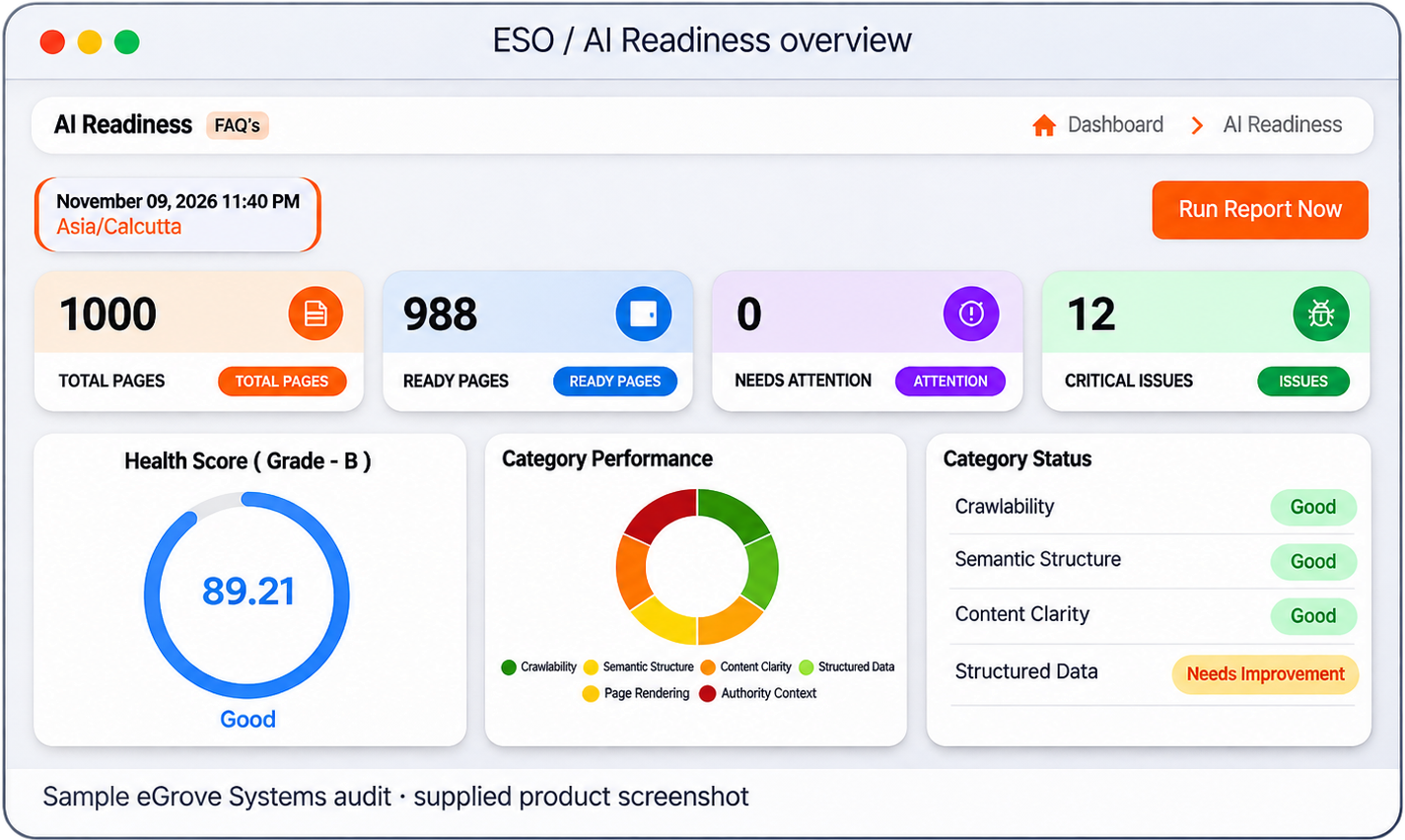
Use the dashboard’s health score as an AI readiness index for ESO’s audit checks. Review category performance and individual URLs to understand the findings behind the score.
Turn findings into action
Inspect the evidence and recommended improvements, then download the report to share with your content and development teams.
Inside the report
See the findings.
Understand the next step.
Real product screenshots from the supplied eGrove Systems audit.
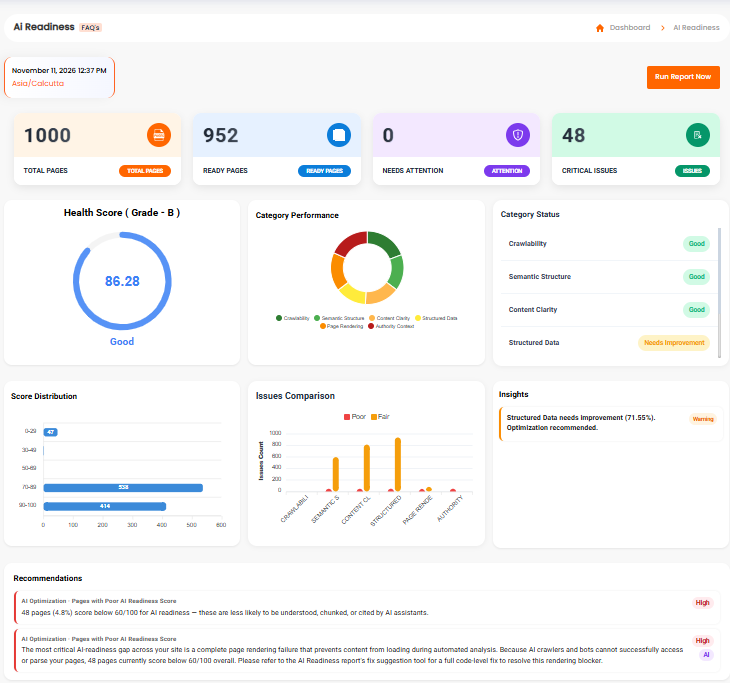
Overview: explore the health score, category status, score distribution, insights, and recommendations.
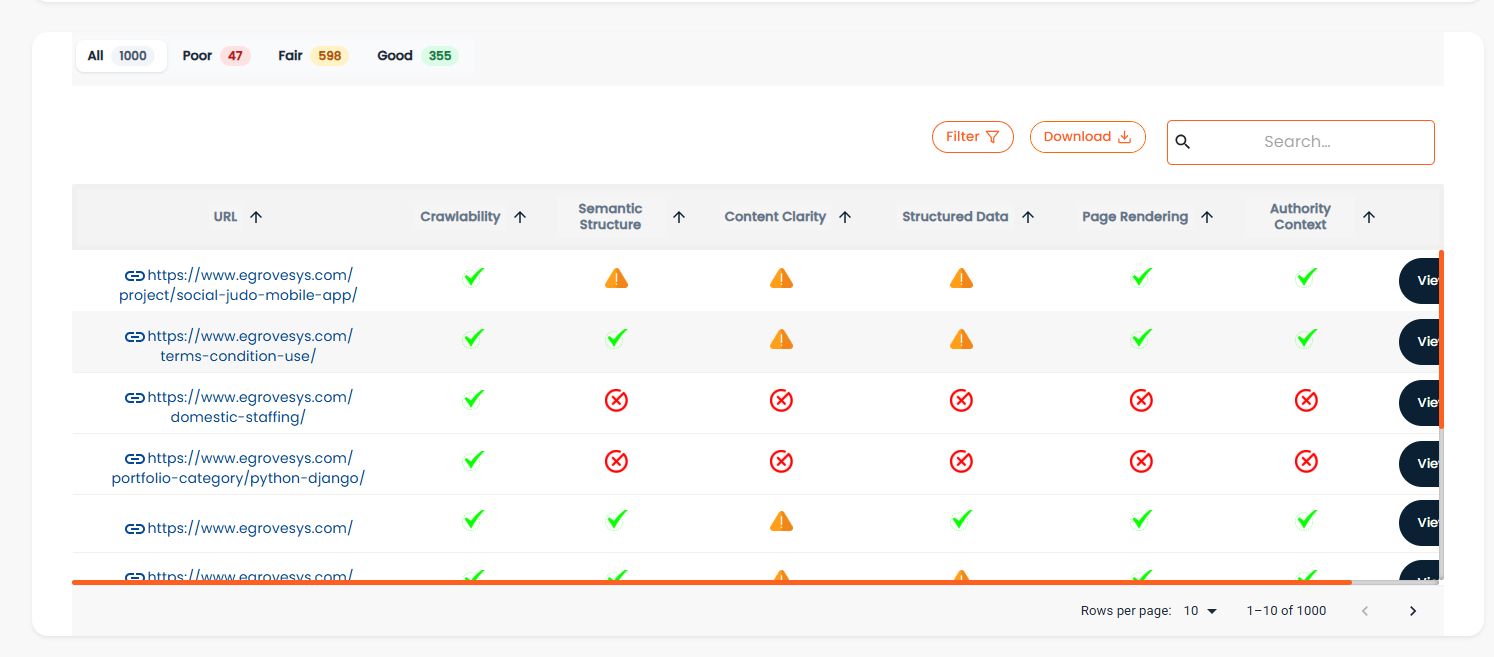
Page-level checks: review individual URLs and category indicators. The screenshot includes original sample data.
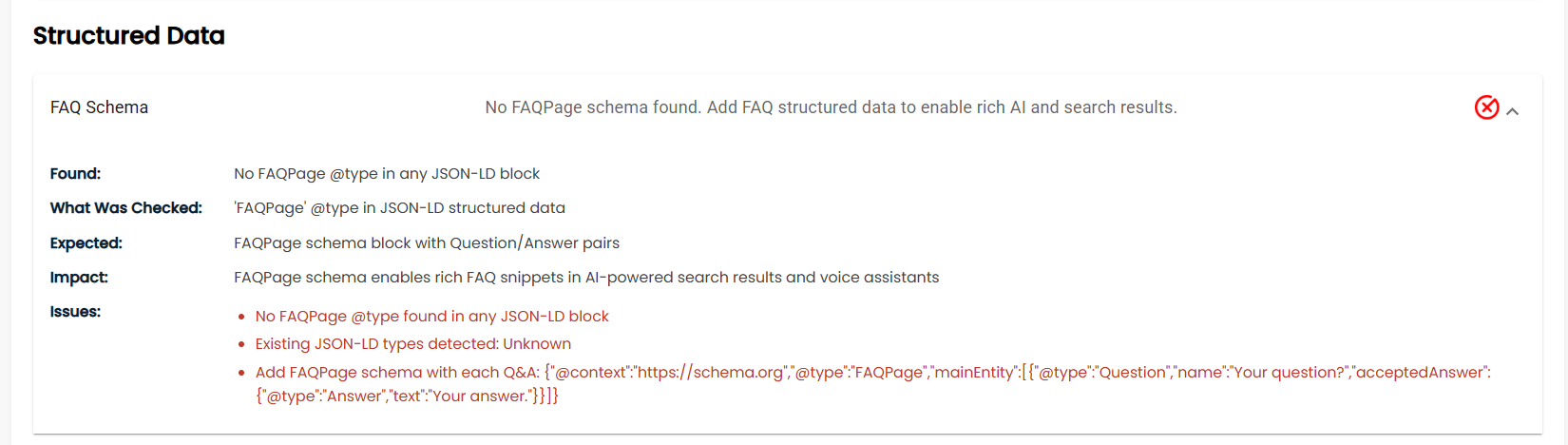
Issue details: view what was checked, what was found, and the expected result. Report recommendations should be evaluated for the page’s purpose.
Explore the page-level table and category indicators to locate findings.
Inspect what was checked, the observed result, and the report’s recommendation.
Prioritize findings for the page’s purpose. Individual checks are audit heuristics, not universal AI inclusion requirements.
Readiness + visibility
Build the foundation.
Then measure your presence.
Search engines and AI search platforms need useful, accessible information. An AI readiness audit helps you review the website foundations that support discovery and understanding.
If your goal is better ChatGPT ranking, Gemini ranking, or visibility across other AI platforms, use citation monitoring to check whether your brand is mentioned or cited in answers to relevant questions. Review these results alongside your audit findings to guide further improvements.
AI Readiness Audit
Investigate technical and content gaps on your website.
AI Citation Report
Explore observed brand appearances across supported AI platforms.
Your next step
Review findings, apply relevant improvements, and monitor outcomes over time.
Know what to improve next
Ready to see how your website measures up?
Identify potential gaps and give your team a clearer starting point for AI search readiness.
Run an AI readiness audit to review crawler access, semantic structure, content clarity, structured data, page rendering, and supporting context. Inspect individual findings to decide which changes are relevant to your pages.
Make your important pages accessible and indexable, provide clear and useful answers, organize content logically, and use accurate structured data where relevant. Address audit findings in context and monitor whether your visibility changes.
No. The score summarizes ESO’s audit checks. AI platforms also select sources according to the question, relevance, and their own systems. Readiness and observed citations are different measurements.
Not by itself. Treat missing markup as a finding to review, not proof of why a page was omitted. Use schema only where it accurately represents visible content; no special AI schema guarantees inclusion.
Run an audit after major content, design, or technical changes, and periodically as part of your website maintenance. Compare findings to see whether previously identified issues have been resolved.
ESO provides a downloadable detailed report with page-level findings, observed and expected results, and recommended improvements for review by your team.