Search visibility is no longer limited to traditional search engine rankings. Customers now use Google, AI Overviews, ChatGPT, Gemini, Copilot, Perplexity, and other AI-powered tools to research products, compare services, and make decisions.
A brand may perform well in conventional search results while receiving limited visibility in AI-generated responses. Conversely, a website may be cited by AI platforms even when some of its pages do not hold top organic positions.
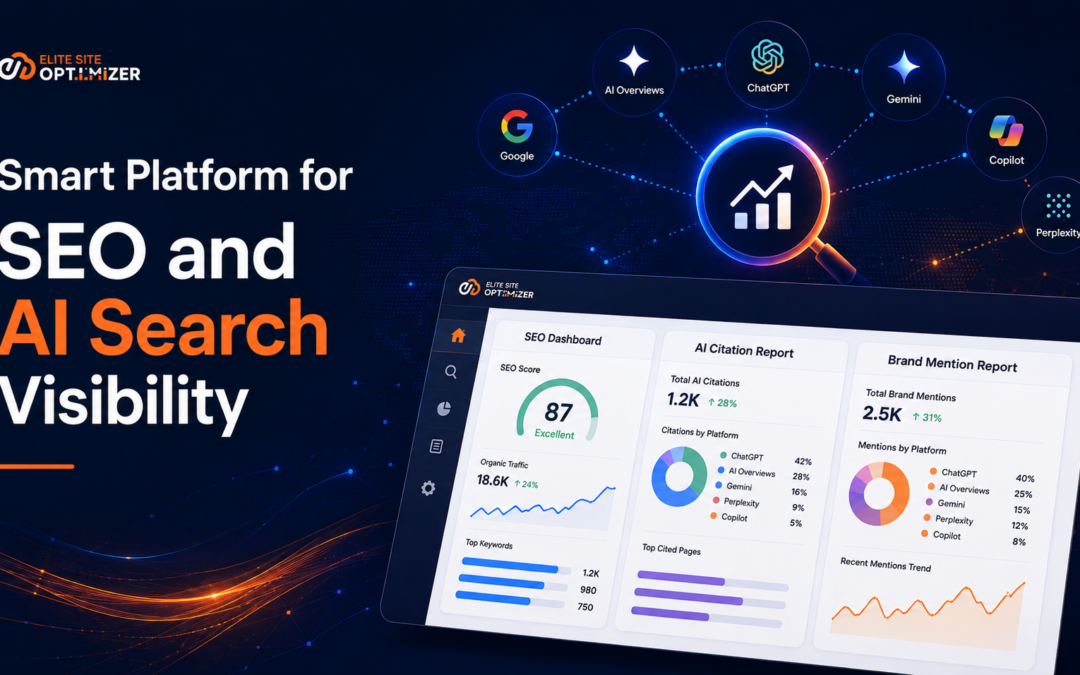
This changing environment makes it essential to review traditional SEO performance alongside AI citations and brand mentions. ESO supports this process through a unified platform containing separate screens for the SEO Dashboard, AI Citation Report, and Brand Mention Report.
What Is SEO Visibility?
SEO visibility reflects how prominently a website appears in traditional search engine results for relevant keywords and queries.
It can be evaluated through indicators such as:
- Keyword rankings
- Organic search traffic
- Search impressions
- Click-through rates
- Website conversions
- Indexed pages
- Backlink growth
- Technical SEO performance
- Competitor URLs
- Visibility trends
Strong SEO visibility helps customers discover a business when searching for relevant products, services, solutions, or information. However, these metrics alone no longer present a complete picture of digital search visibility.
What Is AI Search Visibility?
AI search visibility reflects how frequently a brand, website, product, or service appears in AI-generated answers.
Instead of displaying only a list of links, AI search tools often summarize information, cite selected webpages, and mention relevant brands directly within their responses. Monitoring this activity helps businesses understand whether AI platforms recognize their content and include it in answers to relevant prompts.
Confirmed AI search visibility metrics include:
- AI Visibility Score
- Total brand mentions
- AI citations
- Prompts and queries
- Cited URLs
- Competitor URLs
- Mention sentiment
- AI provider distribution
- Visibility trends
These insights allow marketers to review how their brand appears across AI-powered discovery experiences.
Current Search Visibility Trends
“AI-powered search is changing how customers discover and evaluate brands.
- More than one billion monthly users: Google reported in May 2026 that AI Mode had surpassed one billion monthly users, with query volume more than doubling every quarter.
- More AI-generated search results: Comscore reported that over 30% of Google desktop searches displayed an AI Overview in 2025, increasing from 23% in April 2025.
- Lower traditional result clicks: Pew Research Center found that users clicked a traditional search result during 8% of visits containing an AI summary, compared with 15% when no summary appeared.
- Limited citation clicks: The same Pew study found that users clicked a source inside an AI summary during only 1% of visits.
Why it matters: Rankings and organic traffic no longer show the complete search journey. Businesses must also review AI citations, brand mentions, sentiment, prompts, and visibility trends.
Sources: Google Search, Comscore AI Intelligence Report, and Pew Research Center.”
Why Separate Reporting Creates Challenges
SEO and AI visibility reports provide different but complementary insights. When these reports are spread across unrelated platforms, spreadsheets, and reporting systems, marketers may struggle to understand the brand’s broader search presence.
Incomplete Visibility Insights
A website may experience changes in keyword rankings while receiving new citations or mentions from AI platforms. Reviewing only traditional SEO metrics would not show this additional visibility.
Similarly, a website may maintain stable organic rankings but receive few AI citations or brand mentions. Without AI reporting, the business could overlook an important visibility gap.
Slower Analysis
Switching between unrelated platforms can make reporting more time-consuming. Teams may need to collect information manually before they can compare SEO rankings, cited URLs, AI mentions, prompts, and visibility trends.
Accessing these reports within the same platform creates a more efficient review process.
Disconnected Metrics
SEO and AI search reporting use different measurements. Traditional reports focus on rankings, traffic, impressions, and website performance, while AI reports evaluate citations, mentions, sentiment, prompts, and provider distribution.
A unified platform makes these different insights easier to access and review without suggesting that the platform automatically calculates direct correlations between them.
Missed Content Opportunities
SEO reports can identify important keywords and landing pages. AI Citation and Brand Mention Reports can show the queries or prompts associated with citations and mentions.
Reviewing this information together can help marketers identify subjects that may require stronger, clearer, or more authoritative content.
Why Unified SEO and AI Reporting Matters
Unified reporting gives businesses a broader understanding of how their brand appears across traditional and AI-powered search experiences.
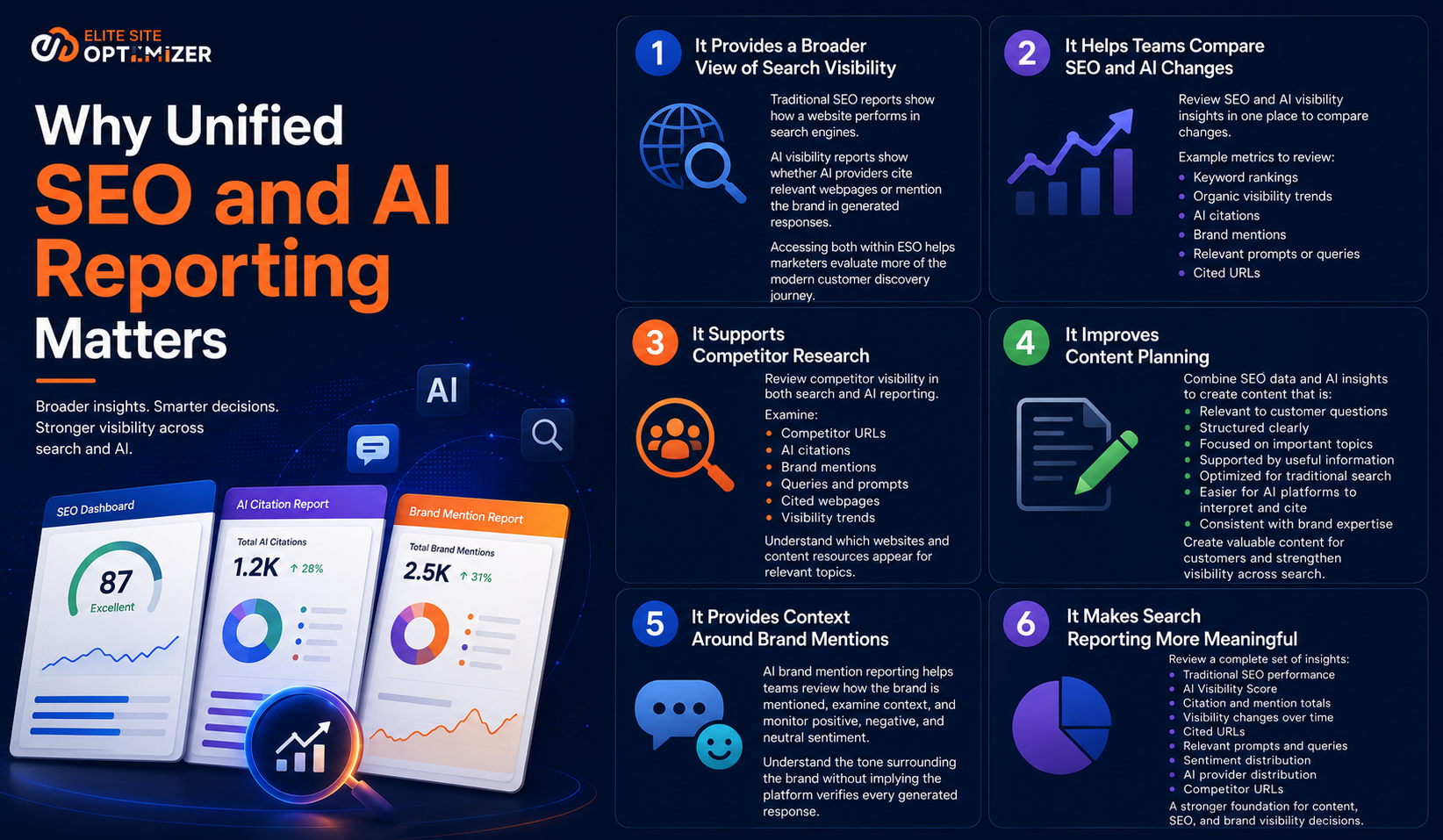
1. It Provides a Broader View of Search Visibility
Traditional SEO reports show how a website performs in search engines. AI visibility reports show whether AI providers cite relevant webpages or mention the brand in generated responses.
Accessing both types of reporting within ESO helps marketers evaluate more of the modern customer discovery journey.
2. It Helps Teams Compare SEO and AI Changes
Reviewing SEO and AI visibility insights within the same platform helps teams compare changes in traditional search performance with AI citations and mentions.
For example, after publishing or updating a page, marketers can separately review:
- Changes in keyword rankings
- Organic visibility trends
- AI citations
- Brand mentions
- Relevant prompts or queries
- Cited URLs
These reports provide useful context for analysis without implying that ESO automatically attributes an SEO change to a specific AI visibility outcome.
3. It Supports Competitor Research
Competitor visibility is an important part of both SEO and AI search analysis. ESO reporting can help teams review competitor URLs appearing in relevant search and AI reporting.
Businesses can examine:
- Competitor URLs
- AI citations
- Brand mentions
- Queries and prompts
- Cited webpages
- Visibility trends
This information helps marketers understand which websites and content resources are appearing for relevant topics.
4. It Improves Content Planning
SEO data can reveal what audiences search for, while AI reports provide information about the prompts and queries connected to AI-generated results.
Together, these insights can support content that is:
- Relevant to customer questions
- Structured clearly
- Focused on important search topics
- Supported by useful information
- Optimized for traditional search
- Easier for AI platforms to interpret and cite
- Consistent with the brand’s expertise
The objective is to create valuable content for customers while strengthening visibility across different search experiences.
5. It Provides Context Around Brand Mentions
AI brand mention reporting helps teams review how their brand is mentioned, examine mention context, and monitor positive, negative, and neutral sentiment.
This allows businesses to understand the tone surrounding their brand without implying that the platform automatically verifies the factual accuracy of every generated response.
6. It Makes Search Reporting More Meaningful
Marketing teams and business leaders need clear insights about whether their search presence is improving.
Unified SEO and AI reporting can help them review:
- Traditional SEO performance
- AI Visibility Score
- Citation and mention totals
- Visibility changes over time
- Cited URLs
- Relevant prompts and queries
- Sentiment distribution
- AI provider distribution
- Competitor URLs
This provides a more complete foundation for content, SEO, and brand visibility decisions.
Essential Metrics to Review
An effective search visibility strategy should include confirmed SEO and AI reporting metrics.
Traditional SEO Metrics
- Organic search traffic
- Search impressions
- Keyword rankings
- Click-through rates
- Organic conversions
- Indexed pages
- Backlink growth
- Technical SEO issues
- Competitor URLs
- Visibility trends
AI Search Visibility Metrics
- AI Visibility Score
- Total Mentions
- Citations
- Prompts and Queries
- Cited URLs
- Competitor URLs
- Positive, Negative, and Neutral Sentiment
- AI Provider Distribution
- Visibility Trends
Comparing SEO and AI Insights
By reviewing SEO and AI reports together, businesses can compare insights such as:
- High-ranking pages and their presence among cited URLs
- Organic visibility changes and AI citation trends
- Brand mentions associated with relevant prompts
- Competitor URLs appearing in search and AI reports
- Pages receiving AI citations and their traditional SEO performance
- Sentiment trends surrounding AI brand mentions
- Citation distribution across different AI providers
These comparisons require thoughtful interpretation. They should not be presented as automatically calculated correlations unless the platform specifically provides that functionality.
How Businesses Can Improve Search and AI Visibility
Traditional SEO and AI visibility both benefit from clear, relevant, credible, and accessible information.
Businesses can strengthen their visibility by:
- Publishing original and expert-led content
- Answering specific customer questions clearly
- Creating focused product and service pages
- Using descriptive headings and logical page structures
- Maintaining consistent brand information
- Adding relevant structured data
- Earning authoritative backlinks and mentions
- Updating outdated content regularly
- Demonstrating practical experience and subject expertise
- Reviewing citations, mentions, prompts, and sentiment trends
These practices help search engines, AI platforms, and customers understand the brand and its expertise.
The Future of Search Reporting
Search reporting can no longer focus exclusively on rankings, organic traffic, and backlinks. AI-generated responses have become an important part of how people research topics, evaluate businesses, and discover solutions.
This development does not make traditional SEO irrelevant. Instead, it expands the number of search experiences businesses must evaluate.
ESO brings the SEO Dashboard, AI Citation Report, and Brand Mention Report into the same platform. Although these reports appear on separate screens, together they provide a broader view of traditional search performance, AI citations, brand mentions, sentiment, and visibility trends.
Conclusion
SEO visibility and AI search visibility are becoming closely connected parts of the customer discovery journey.
A unified platform helps businesses access traditional SEO reporting and AI visibility insights in one environment while preserving the distinct purpose of each report. Teams can review keyword performance through the SEO Dashboard, examine cited content through the AI Citation Report, and evaluate mentions and sentiment through the Brand Mention Report.
By reviewing these reports together, businesses can identify visibility trends, improve content planning, monitor relevant competitor URLs, and better understand how their brands appear across traditional and AI-powered search.
The future of search visibility is not about choosing between SEO and AI reporting. It is about using both to build a clearer, more informed digital strategy.
Ready to improve your website’s search performance?
Sign up for Elite Site Optimizer and start analyzing your website’s SEO, accessibility, performance and content quality.
Start Your Free SignupRelated Posts