

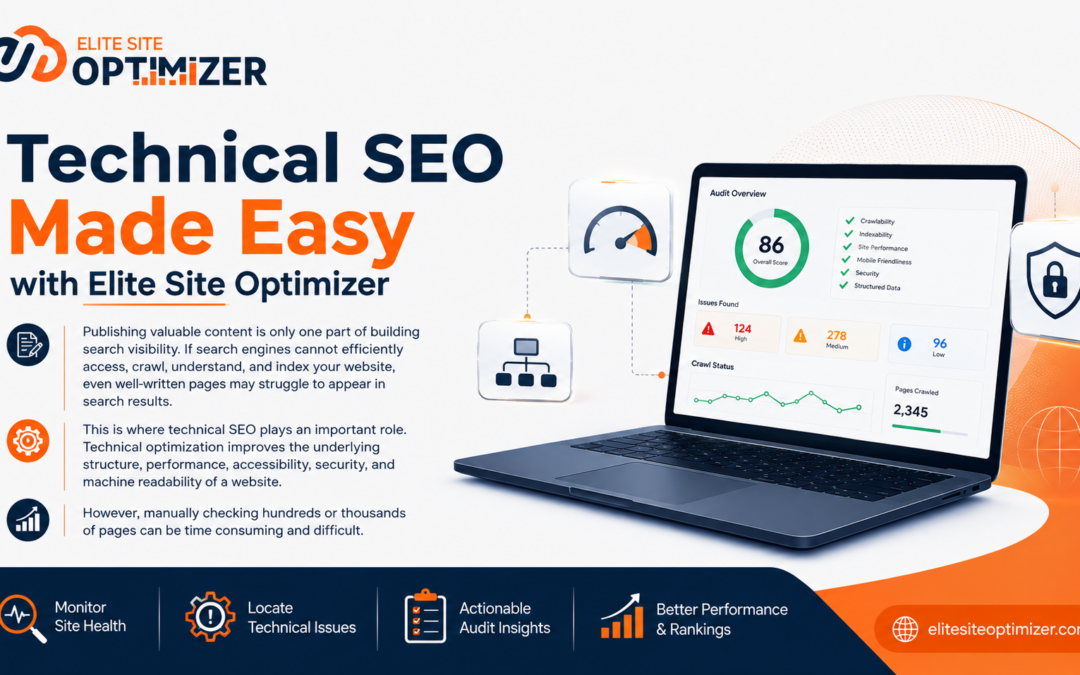
Publishing valuable content is only one part of building search visibility. If search engines cannot efficiently access, crawl, understand, and index your website, even well-written pages may struggle to appear in search results.
This is where technical SEO plays an important role.
Technical optimization improves the underlying structure, performance, accessibility, security, and machine readability of a website. However, manually checking hundreds or thousands of pages can be time-consuming and difficult.
Elite Site Optimizer simplifies this process by helping SEO professionals, marketers, developers, and agencies monitor site health, locate technical issues, and turn audit findings into clear optimization actions.
What Is Technical SEO?
Technical SEO focuses on making a website easier for search engines to crawl, interpret, and index. It also supports a faster, safer, and more consistent experience for website visitors.
A technical website audit typically examines:
- Crawlability and indexability
- Page indexing differences
- Broken links and inaccessible pages
- Website speed and performance
- Mobile usability
- Sitemap configuration
- Schema markup and structured data
- Redirects and HTTP status codes
- Website accessibility
- Source-code quality
- SSL and security concerns
- Changes affecting SEO performance
These factors may operate behind the scenes, but they can directly influence organic visibility, user experience, and website reliability.
Why Technical Website Optimization Can Be Complicated
Technical problems rarely appear in isolation. A website may contain broken links, slow pages, invalid schema, missing metadata, accessibility barriers, security vulnerabilities, and indexing gaps at the same time.
Discovering these issues manually requires repeated page inspections and close coordination between SEO specialists, content teams, designers, developers, and security teams. It can also be difficult to understand which issues require immediate action.
Elite Site Optimizer brings multiple website auditing capabilities into a single platform, allowing teams to review technical findings through structured reports and prioritize improvements based on their severity and potential impact.
How Elite Site Optimizer Simplifies Technical SEO
1. Conduct Comprehensive Website Audits
Elite Site Optimizer’s Site Analysis helps teams evaluate the overall technical and on-page condition of a website. Instead of inspecting URLs individually, users can scan multiple pages and review the issues affecting site health from a centralized report.
The audit can help uncover:
- Missing or duplicate page titles
- Missing meta descriptions
- Incorrect heading structures
- Broken internal and external links
- Inaccessible pages
- Redirect and HTTP status-code problems
- Missing image attributes
- Crawlability concerns
- Inconsistent page configurations
Elite Site Optimizer also provides a Page Index Report, which compares the number of pages crawled by ESO with the number of pages indexed by Google. A significant difference between these figures can indicate that important pages are not being indexed or that unnecessary pages are being crawled.
This comparison helps teams investigate possible indexing problems, content duplication, crawl restrictions, canonical issues, or low-value pages.
2. Find and Evaluate Broken Links
Broken links interrupt navigation and can make it harder for search engines to discover connected content. They often appear when URLs are modified, products are removed, pages are deleted, or external resources are relocated.
Elite Site Optimizer’s Link Checker provides more than a basic list of broken URLs. It helps teams examine:
- Link status codes
- Anchor text
- Internal and external links
- Linked domains
- Pages containing problematic links
This information helps SEO and development teams decide whether a link should be corrected, redirected, replaced, or removed.
Maintaining healthy links can improve navigation, preserve internal linking pathways, reduce crawl errors, and direct visitors to relevant information.
3. Evaluate Website Performance
Website performance influences how users experience a page. Slow-loading pages can increase abandonment, reduce conversions, and make it difficult for visitors to complete important actions.
Performance Analysis helps teams locate factors that may affect loading speed and page experience, including:
- Large or unoptimized images
- Excessive scripts
- Unoptimized CSS and JavaScript
- Slow server responses
- Render-blocking resources
- Inefficient page elements
- Poor mobile performance
These findings give marketers and developers a clearer starting point for improving speed, responsiveness, and usability.
For an e-commerce website, performance improvements can be especially important. Product images, tracking scripts, payment integrations, third-party plugins, and large product catalogs can make pages heavier and slower if they are not properly optimized.
4. Validate Schema Markup
Schema markup provides structured information that helps search engines understand the purpose and context of website content. It may be used to describe products, organizations, articles, events, FAQs, local businesses, reviews, and other entities.
Incomplete or invalid markup can prevent search engines from interpreting the information correctly.
Elite Site Optimizer’s Schema Analysis helps teams inspect structured data across their website and find potential implementation problems.
Accurate schema markup can support:
- Better machine understanding
- Clearer entity relationships
- Eligibility for relevant rich results
- Improved product and business information
- Greater readiness for search and AI-powered discovery
Schema implementation does not guarantee enhanced search results. However, well structured markup makes important page information easier for search engines and AI systems to process.
5. Track Website Changes with the Regression Report
Website updates can unintentionally introduce technical problems. A platform migration, design update, new plugin, template modification, or content release may affect metadata, headings, links, schema, and other important elements.
Elite Site Optimizer’s Regression Report compares the latest audit results with the previous audit. This allows teams to see whether issues have increased, decreased, or remained unresolved following a website change.
The report includes:
- By Issues charts to show changes in detected problems
- By Severity charts to classify changes according to their level of importance
The Regression Report is particularly useful during:
- Website redesigns
- CMS or platform migrations
- Template modifications
- Major content updates
- Product releases
- Development deployments
This comparison gives teams a clearer view of whether a release improved site health or introduced new technical concerns.
6. Improve Website Accessibility
Website accessibility ensures that people with different abilities can navigate, understand, and interact with online content. It is also closely connected to technical quality and user experience.
Elite Site Optimizer’s accessibility auditing capabilities help teams identify potential barriers involving:
- Missing alternative text
- Incorrect heading hierarchy
- Insufficient color contrast
- Missing form labels
- Unclear link descriptions
- Keyboard navigation
- Improperly structured page elements
Correcting these issues can improve usability, strengthen page structure, and make website content accessible to a wider audience.
Accessibility auditing should be treated as an ongoing process rather than a one-time check. As pages, forms, images, and interactive elements are added, new accessibility concerns may appear.
7. Help Search Engines Find Important Content Faster with Sitemaps
A properly organized sitemap helps search engines discover important content more efficiently. This can be particularly valuable for large websites, e-commerce stores, media platforms, and websites that publish or update content frequently.
Elite Site Optimizer supports four types of sitemaps:
- XML Sitemap: Provides search engines with a structured list of important website URLs.
- HTML Sitemap: Helps visitors and search engines navigate the main sections of a website.
- Image Sitemap: Helps search engines find product images and other important visual content.
- Video Sitemap: Provides information about video content available across the website.
Image sitemaps are especially useful for e-commerce businesses because product images may contribute to visibility in image-based search results. Video sitemaps can help websites communicate information about demonstrations, tutorials, webinars, and other video assets.
Elite Site Optimizer also allows teams to work with URL priority values and provides steps for submitting sitemaps to search engines. Before submission, teams should confirm that the sitemap includes valuable, indexable pages while excluding redirects, error pages, duplicates, and unnecessary parameter-based URLs.
8. Protect Search Visibility with Five Security Audits
Website security affects more than technical infrastructure. Vulnerabilities, unsafe connections, browser warnings, or exposed source-code issues can damage visitor trust and interrupt access to important pages. A compromised website may also experience downtime, unwanted redirects, injected content, or search visibility losses.
Elite Site Optimizer provides five dedicated security checks:
Vulnerability Audit
The Vulnerability Audit helps identify known weaknesses that could expose the website or its applications to security threats. Detecting these risks allows technical teams to investigate affected components and apply the appropriate security updates.
Container Audit
Modern applications often use containers to package and deploy software. The Container Audit examines container-related components for known security concerns that could affect the website or application environment.
Source Code Audit
The Source Code Audit evaluates code-related risks that may be present in the website or application. It helps development teams locate potentially unsafe patterns, exposed information, and code-level weaknesses requiring further review.
Git Repository Audit
Git repositories may accidentally contain sensitive information, insecure configurations, credentials, or vulnerable dependencies. The Git Repository Audit helps teams inspect repository-level risks before they affect production systems.
SSL Audit
The SSL Audit examines the website’s SSL configuration and secure connection status. A properly configured SSL certificate helps protect information transferred between the visitor and the website while preventing disruptive browser security warnings.
These audits provide a broader view of website security than a basic HTTPS check. They help SEO, development, and security teams recognize issues that could affect user trust, website availability, and organic performance.
ChatGPT Image Aug PM
Turning Audit Findings into Action
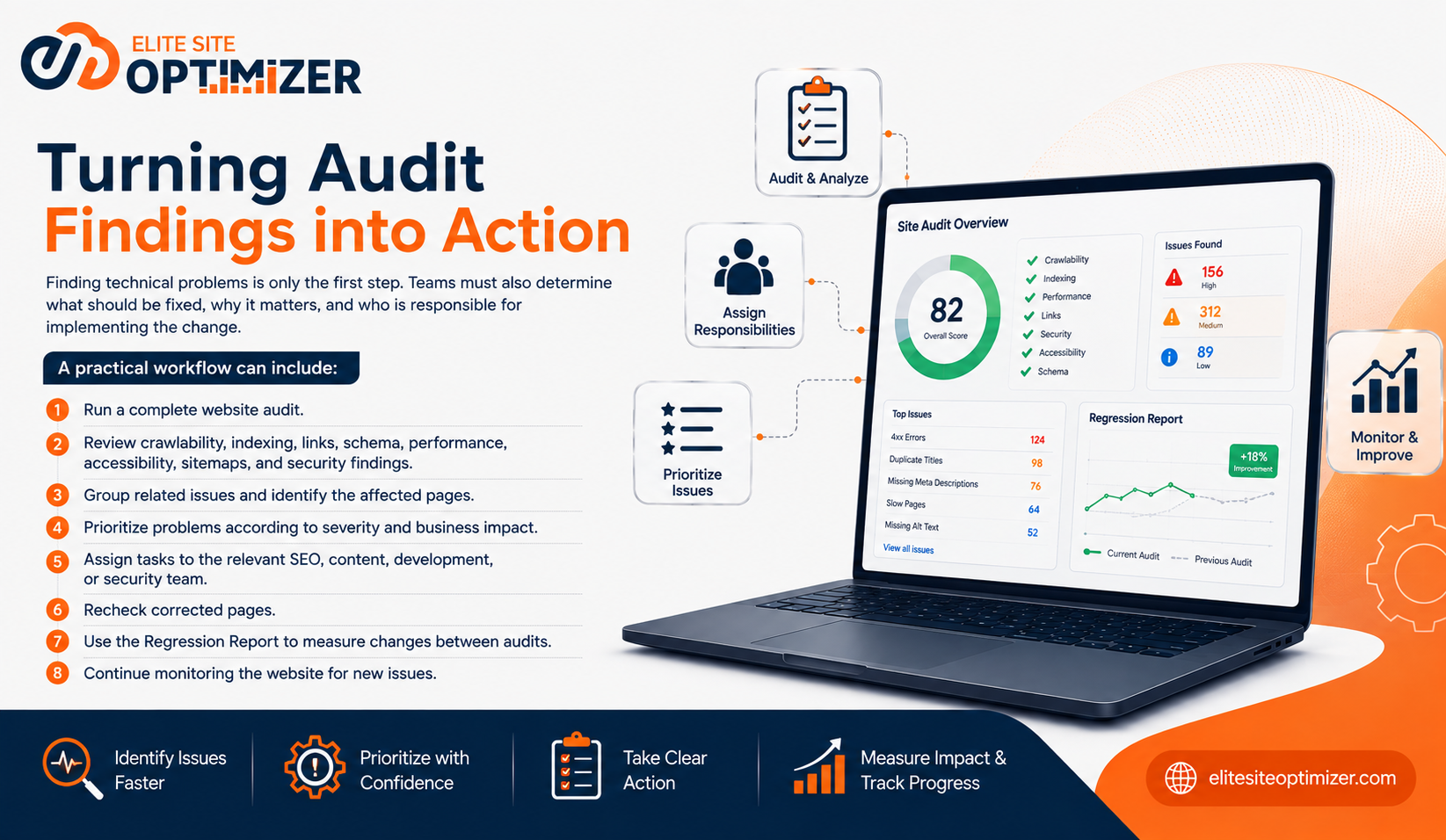
Finding technical problems is only the first step. Teams must also determine what should be fixed, why it matters, and who is responsible for implementing the change.
A practical workflow can include:
- Run a complete website audit.
- Review crawlability, indexing, links, schema, performance, accessibility, sitemaps, and security findings.
- Group related issues and identify the affected pages.
- Prioritize problems according to severity and business impact.
- Assign tasks to the relevant SEO, content, development, or security team.
- Recheck corrected pages.
- Use the Regression Report to measure changes between audits.
- Continue monitoring the website for new issues.
This process turns optimization from an occasional technical project into an ongoing site-quality workflow.
” Technical SEO is evolving beyond rankings as AI search reshapes discovery. HTTP Archive’s 2025 research highlights crawlability, structured data, performance and accessibility as essential foundations. Meanwhile, AI chatbot referrals to major publishers rose over 2,100% between May 2024 and February 2025, reinforcing the need for machine-readable, secure and well structured websites. “
Which Issues Should Be Fixed First?
Not every warning carries the same level of risk. Businesses should generally begin with problems that prevent important pages from being accessed, crawled, indexed, or safely used.
Critical Issues
- Important pages blocked from crawling
- Server errors
- Incorrect noindex directives
- Major security vulnerabilities
- SSL configuration problems
- Broken canonical implementation
- Migration and redirect failures
High-Priority Issues
- Important pages missing from Google’s index
- Broken internal links
- Slow-loading pages
- Invalid structured data
- Orphan pages
- Mobile usability problems
- Source-code or repository risks
Improvement Opportunities
- Missing metadata
- Heading inconsistencies
- Missing image alternative text
- Minor accessibility concerns
- Weak internal linking
- Non-critical source-code warnings
This prioritization prevents teams from spending excessive time on minor warnings while more serious site-health problems remain unresolved.
How Technical SEO Supports AI Search Visibility
Website optimization is no longer limited to conventional search rankings. Content is increasingly discovered through AI-powered search experiences, answer engines, and generative platforms.
These systems rely on many of the same foundations used by traditional search engines. Website pages must be accessible, structured, internally connected, secure, and understandable to machines.
A technically optimized website supports AI discovery through:
- Clear page structures
- Accessible content
- Accurate schema markup
- Strong internal linking
- Consistent entity information
- Crawlable source content
- Reliable website performance
- Secure website connections
Elite Site Optimizer combines technical auditing with AI Readiness analysis, helping businesses examine whether their websites are prepared for both traditional search engines and emerging AI-driven discovery.
Who Can Benefit from Elite Site Optimizer?
Elite Site Optimizer can support:
- SEO professionals managing multiple websites
- Digital marketing agencies conducting client audits
- In-house teams monitoring website performance
- Developers validating releases and migrations
- Security teams reviewing technical risks
- E-commerce businesses managing changing product pages
- Enterprises maintaining large websites
- Content teams identifying optimization opportunities
By centralizing site-health reports, the platform also supports better collaboration between technical and non-technical teams.
Final Thoughts
Managing site health does not have to involve inspecting every URL manually or switching between disconnected audit platforms. Elite Site Optimizer provides a structured way to evaluate crawlability, indexing, links, schema, performance, accessibility, sitemaps, security, and website changes.
Its detailed Page Index Report, Regression Report, sitemap capabilities, and five specialized security audits give teams deeper visibility into issues that could affect users, search engines, and AI-powered discovery platforms.
Together, these tools make it easier to prioritize improvements, coordinate with the right teams, and identify problems early before they cause lasting damage to traffic, trust, or website performance.
Explore Elite Site Optimizer and start building a website that is easier to discover, understand, secure, and optimize.
Ready to improve your website’s search performance?
Sign up for Elite Site Optimizer and start analyzing your website’s SEO, accessibility, performance and content quality.
Start Your Free Signup