
Introduction
For years, businesses have relied on Google rankings as the primary measure of online visibility. Being on the first page meant higher traffic, better engagement, and increased opportunities to convert visitors into customers. Traditional SEO focused on keywords, backlinks, and technical performance, with organizations investing heavily to improve rankings and create valuable content.
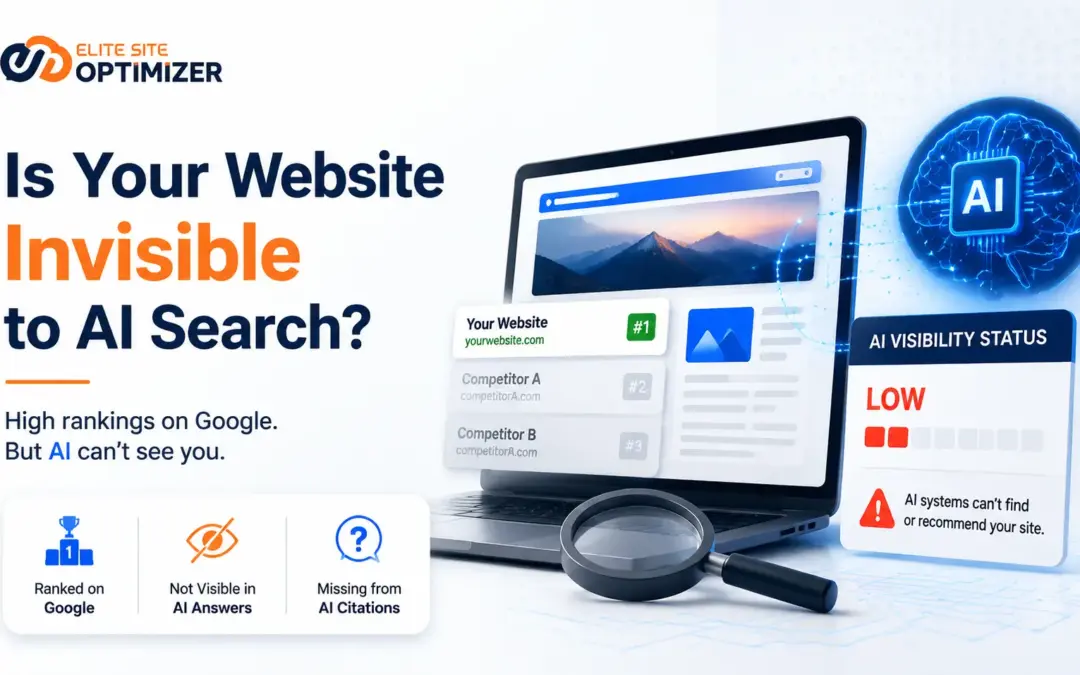
Many websites remain unseen by AI-powered search engines, even if they rank well on Google. In 2026, platforms like ChatGPT, Claude, Perplexity, and Gemini are becoming primary sources for user queries, summarizing answers and choosing content based on clarity, relevance, and trust. If your site lacks structured content, AI-friendly citations, or clear messaging, it risks being invisible in AI responses. Business owners, marketers, and SEO professionals must now optimize not just for traditional search, but also for AI visibility, ensuring their website is referenced, trusted, and discoverable in this new generation of AI-driven search results.
This article explains why websites struggle with AI recognition, how businesses can check website visibility, and actionable steps to improve website visibility. By following these best practices, businesses can improve their visibility across AI search platforms and increase their chances of being referenced in AI-generated responses.
The Rise of AI Search
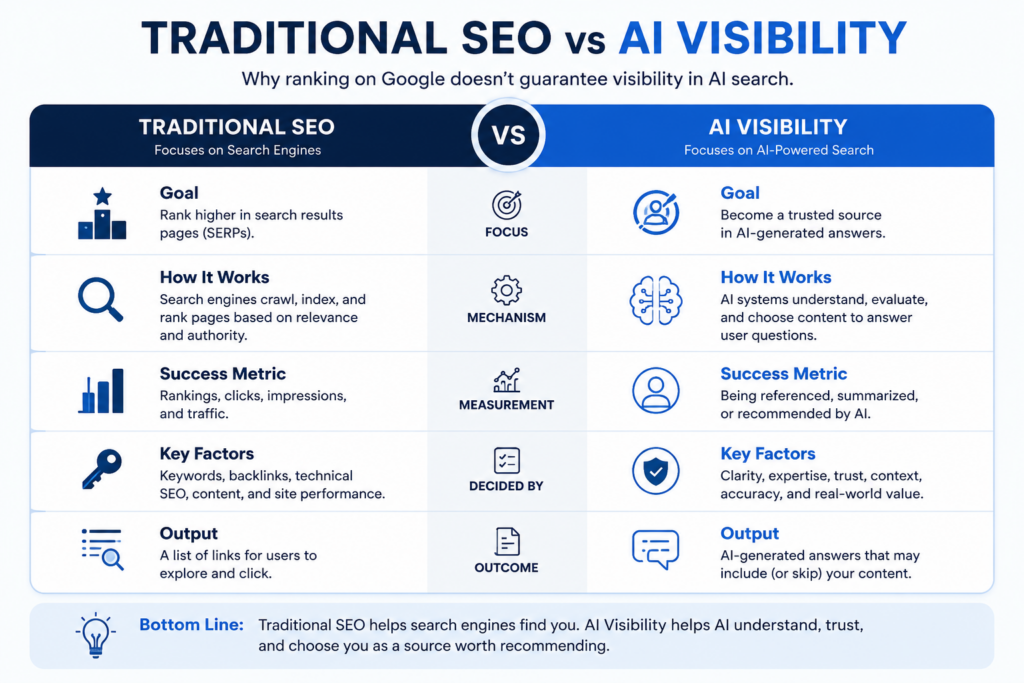
AI Visibility vs Traditional SEO
Search has evolved from keyword-based queries to full conversational interactions. Previously, users typed short phrases, compared multiple results, and decided which website provided the best answer. Metrics such as impressions, click-through rates, and organic traffic were sufficient measures of success.
AI-powered search changes the game. Users now ask detailed questions, and AI systems synthesize information from multiple sources, generating answers without requiring visits to multiple websites. For instance:
- Which accessibility platform helps businesses achieve WCAG compliance?
- What is the best eCommerce solution for growing brands?
- Which AI SEO tools improve website performance?
Instead of hundreds of links, AI platforms provide summarized, actionable answers. This makes ai visibility essential: your website must be structured, clear, and authoritative to appear in these summaries.
Businesses must now ask themselves:
- Not just Where does my website rank?
- But, Does AI recognize my website as a reliable source?
Focusing on AI recognition ensures businesses are discovered during critical decision-making stages, complementing traditional SEO efforts.
What Is AI Visibility?
AI visibility refers to how effectively AI-powered systems can discover, understand, and cite your website. While traditional SEO ensures pages are indexed and ranked, AI visibility determines whether your content is trusted and referenced in AI-generated responses.
Key elements of ai visibility include:
- Structured content with headings, bullet points, and schema
- Comprehensive explanations covering related topics
- Demonstrated authority with credible references and case studies
- Consistent branding and entity information across platforms
Websites with strong Google rankings but poor ai visibility often miss out on valuable exposure from AI-powered assistants. Improving AI visibility increases the likelihood your website will be referenced and trusted by intelligent systems.
Signs That Your Website Is Invisible to AI
Businesses can identify AI visibility gaps through several indicators:
1. Brand rarely appears in AI-generated answers
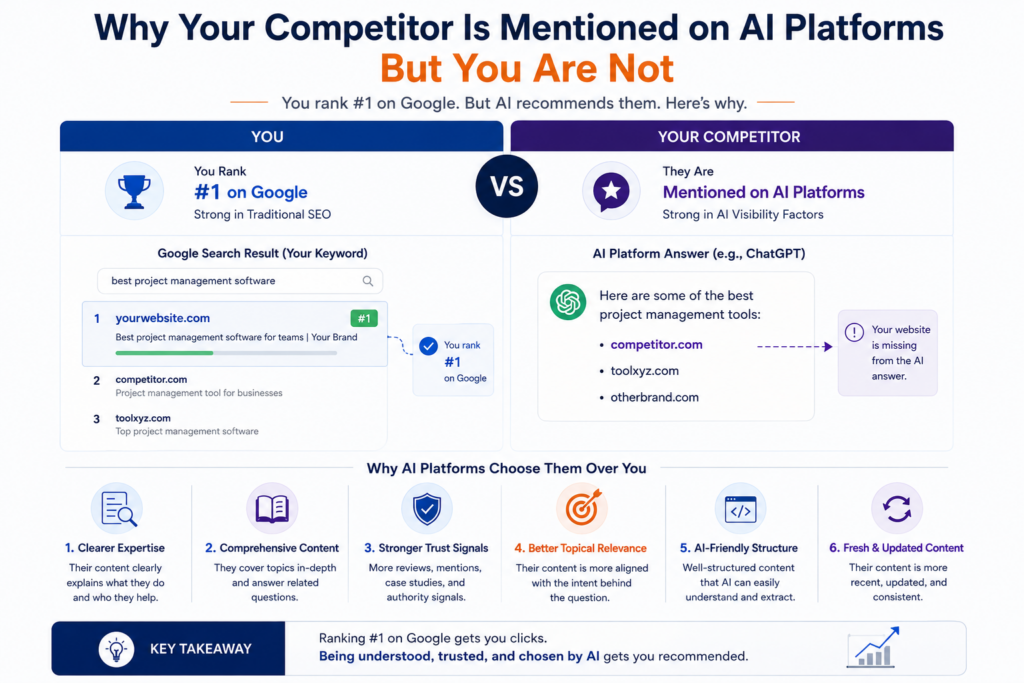
Competitors may be cited even when your website ranks well on Google due to clearer content or stronger authority signals.
2. Competitors receive more AI exposure
Well-organized competitor content is easier for LLMs to parse and reference.
3. Content describes services but lacks expertise
AI prioritizes pages demonstrating knowledge, experience, and actionable insights rather than just listing features.
4. AI provides incomplete or inaccurate descriptions of your business
Responses may not reflect your services accurately, indicating low recognition.
5. Content answers questions but is not cited
AI prefers content that explains concepts, offers examples, and provides context across related topics.
6. Inconsistent online information
Conflicting details about your company across platforms reduce AI confidence in referencing your site.
7. Strong offline reputation not reflected online
AI cannot cite expertise that isn’t represented in publicly available content
If multiple indicators are present, it’s time to check website visibility and implement strategies to improve AI recognition.
Why Google Rankings Don’t Guarantee AI Recognition
High Google rankings do not automatically ensure AI citations. Traditional SEO focuses on:
- Keyword relevance
- Backlinks
- Technical performance
- User experience metrics
AI systems evaluate additional factors:
- Content Readability: Ensure AI can quickly interpret your text, tables, and media to generate accurate answers.
- Credibility & Expertise: Highlight authoritative sources, credentials, and trust signals to increase AI citations.
- Logical Structure: Use clear headings, bullet points, lists, and schema markup so AI can parse content efficiently.
- Answer Completeness: Provide comprehensive responses that directly address user queries to improve relevance in AI results.
- Brand Consistency: Maintain uniform mentions of your business, products, and entities across the web to reinforce AI recognition and trust.
Websites missing these signals may be skipped by AI platforms, even if they rank well. Businesses should combine traditional SEO with AI-focused optimization to improve how their content is interpreted and referenced by modern AI search platforms.
How Businesses Can Improve AI Visibility
Step 1: Structure Content for AI
- Use headings, bullet points, numbered lists, and tables
- Implement FAQ, How To, and Article schema
- Structured pages help AI understand content relationships and context
Step 2: Demonstrate Expertise
- Include real-world examples, case studies, and actionable insights
- Show why your company is qualified to solve customer problems
Step 3: Maintain Consistent Branding
- Uniform entity information across your website, social media, and directories
- Strengthens AI confidence in citing your business
Step 4: Use Authoritative References
- Link to credible sources and industry publications
- Supports AI’s assessment of trust and reliability
Step 5: Monitor AI Citations
- Track your recognition with the ESO AI Citations Checker
- Observe how AI interprets and references your content
Step 6: Update Content Regularly
- AI platforms favor current, accurate, and comprehensive content
- Regular updates help ensure your content remains accurate, relevant, and trustworthy for both users and AI systems.
Step 7: Build Topical Authority
- Create connected content clusters around key expertise
- Covers related topics to strengthen AI recognition and recommendations
Once you’ve identified your AI visibility gaps, the next step is optimization. Explore our
5 Steps for Your Content AI Search Optimization Checklist to build AI-friendly, citation-ready content that supports AEO and GEO best practices.
Benefits of Strong AI Visibility
- Enhanced discoverability in AI-generated responses
- Improved credibility and trust with users and AI platforms
- Increased engagement from AI-driven traffic
- Competitive advantage over uncited competitors
- Long-term recognition as a trusted source of information
Strong AI visibility ensures your content is referenced reliably, helping your brand stay relevant as users increasingly rely on AI for research and recommendations.
Conclusion
Elite Site Optimizer (ESO) helps businesses understand how AI systems perceive their websites through AI visibility analysis and actionable insights. Instead of relying only on traditional rankings, organizations can identify whether their content is being discovered, understood, and considered valuable by modern search experiences.
As search behavior evolves, businesses need to move beyond asking “Where do we rank?” and start asking “Can AI recognize our expertise when customers search for solutions?” Evaluating your AI presence today helps build a stronger foundation for future discoverability, ensuring your brand remains visible when users turn to AI-powered search.
Book Your Free Trial
Ready to improve your website’s search performance?
Sign up for Elite Site Optimizer and start analyzing your website’s SEO, accessibility, performance and content quality.
Start Your Free Signup