
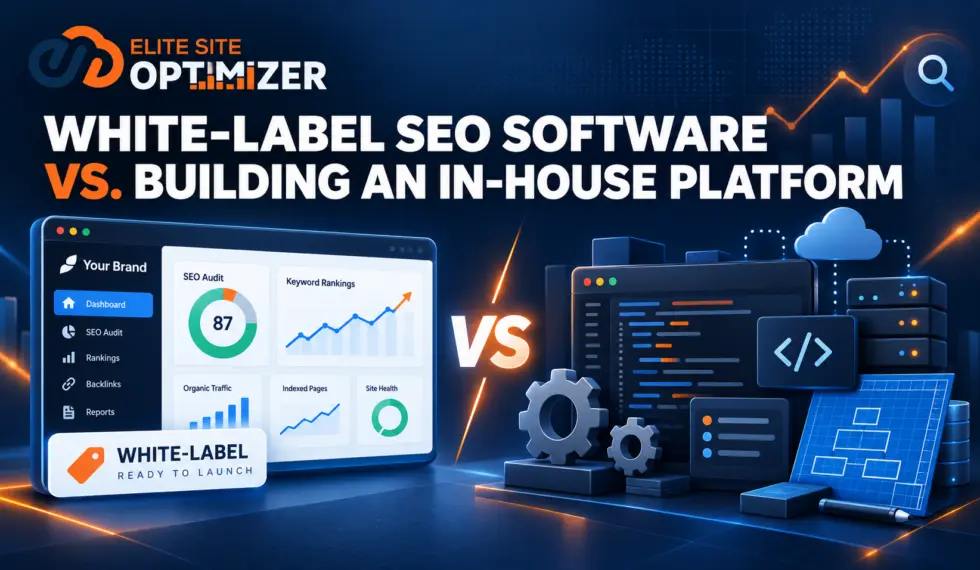
Digital marketing agencies need more than spreadsheets and disconnected SEO tools to manage campaigns efficiently. As an agency grows, it needs a centralized platform for website audits, keyword tracking, backlink monitoring, content analysis, reporting, and client collaboration.
At this stage, agencies usually face an important decision: should they use white label SEO software or build an in-house SEO platform?
Both options can strengthen an agency’s SEO services, but they differ significantly in cost, development time, maintenance, scalability, and risk.
What Is White-Label SEO Software?
White-label SEO software is a ready-made platform that an agency can present under its own brand. The software provider develops and maintains the technology, while the agency customizes client facing elements such as its logo, colors, domain and reports.
It may include:
- Website and technical SEO audits
- Keyword rank tracking
- Backlink monitoring
- Content optimization
- Competitor analysis
- Accessibility and performance checks
- AI search readiness analysis
- Automated and branded client reports
What Does Building an In-House SEO Platform Involve?
An in-house SEO platform is custom-built specifically for an agency’s requirements. The agency is responsible for planning, designing, developing, testing, hosting, securing, maintaining, and upgrading the software.
Building it often requires product managers, designers, developers, QA engineers, DevOps professionals, and cybersecurity support.
Custom development is not a one-time project. Search engines, privacy requirements, and AI-powered discovery platforms continue to change, so the software must evolve with them.
1. Development Cost
Cost is one of the largest differences between the two approaches.
White-label SEO software usually operates through a monthly or annual subscription. This gives agencies predictable expenses and reduces the need for a large initial investment. The provider spreads its development and infrastructure costs across multiple customers, making advanced technology more affordable for an individual agency.
Building an in-house platform requires a substantial upfront budget for planning, design, development, integrations, cloud infrastructure, security testing, and support. Bugs, scope changes, and data-provider price increases can push costs higher.
For most small and mid-sized agencies, white-label software offers a lower financial barrier and a faster path to profitability.
2. Time to Market
A white-label platform can usually be configured and introduced to clients relatively quickly. Once branding, user access, projects, and report settings are prepared, the agency can begin delivering services through the platform.
An in-house system may take several months—or longer—to plan, build, test, and deploy. Its first version may still include only essential functions. Mature audit engines, reliable data pipelines, dashboards, user access, and automated reporting take time.
If an agency wants to launch a new SEO package, improve client retention, or enter the market quickly, the time saved by using an established white-label solution can be a major advantage.
3. Customization and Control
In-house development provides maximum control over workflows, integrations, scoring systems, and proprietary features. This matters when the platform will become a core product or the agency has highly specialized requirements.
White-label software provides customization within the capabilities offered by the vendor. Branding options are usually extensive, but the agency may not control the underlying architecture or product roadmap.
If an agency’s competitive advantage comes from strategy, expertise, and customer relationships, a configurable white-label platform may provide all the control its clients notice.
4. Maintenance and Technical Responsibility
With white-label software, the provider generally manages product updates, bug fixes, infrastructure, data processing, and feature improvements. This allows the agency’s team to focus on SEO strategy, campaign execution, client communication, and sales.
With an in-house platform, software must be monitored, secured, backed up, and updated continuously. Problems can affect reporting accuracy, productivity, and client trust. The agency must retain technical talent after launch.
5. Scalability
An established white-label platform is generally designed to support additional users, websites, reports, and campaigns as an agency grows. The agency can often move to a larger plan instead of rebuilding its infrastructure.
An in-house platform can scale if this is planned during development. Growing data volumes may require database optimization, cloud resources, monitoring, and new engineering work. Poor early decisions can become expensive bottlenecks.
6. Innovation and AI Search Readiness
SEO is expanding beyond traditional search engine results. Businesses increasingly want to understand how their brands and content appear across AI-powered search and answer platforms.
A capable white-label provider can invest continuously in new audits, integrations, AI visibility features, and reporting capabilities. Agencies gain access to these improvements without creating every feature internally.
An in-house team can innovate independently but must fund research, development, testing, and ongoing adaptation. Keeping pace with industry change can distract the agency from its primary services.
Quick Comparison
| Factor | White-Label SEO Software | In-House SEO Platform |
| Initial cost | Lower and predictable | High upfront investment |
| Launch time | Faster | Usually several months or more |
| Branding | Agency-branded experience | Completely customizable |
| Maintenance | Managed by the provider | Managed by the agency |
| Scalability | Typically plan-based | Requires technical planning |
| Feature control | Limited to available options | Full control |
| Technical risk | Lower for the agency | Fully owned by the agency |
| Best suited for | Agencies focused on service growth | Organizations building proprietary technology |
Which Option Is Right for Your Agency?
White label SEO software is usually the better choice when an agency wants to launch quickly, control costs, strengthen its brand, automate reporting, and scale client services without operating a software development department.
Building an in-house platform may be appropriate when the agency has substantial capital, a dedicated technical team, highly specialized requirements, and a long-term strategy to make proprietary software a central business asset.
Before deciding, agencies should calculate the total cost of ownership—not just the initial price. Development salaries, API subscriptions, hosting, cybersecurity, quality assurance, maintenance, upgrades, and opportunity costs should all be considered.
Conclusion
The choice between white label SEO software and an in-house platform is ultimately a choice about where an agency wants to invest its time, money, and expertise.
An in-house platform can deliver complete control, but it also introduces significant cost, technical responsibility, and development risk. White-label SEO software provides a faster and more cost-effective way to deliver branded SEO technology while allowing the agency to focus on client results and business growth.
For agencies that want to expand their service portfolio, improve reporting efficiency, and offer a consistent branded experience, a white-label SEO platform can provide the strongest balance of capability, speed, and scalability.
Ready to offer powerful SEO insights under your own brand? Explore Elite Site Optimizer’s white-label SEO platform and discover how your agency can scale its services with greater efficiency.
Ready to improve your website’s search performance?
Sign up for Elite Site Optimizer and start analyzing your website’s SEO, accessibility, performance and content quality.
Start Your Free Signup