

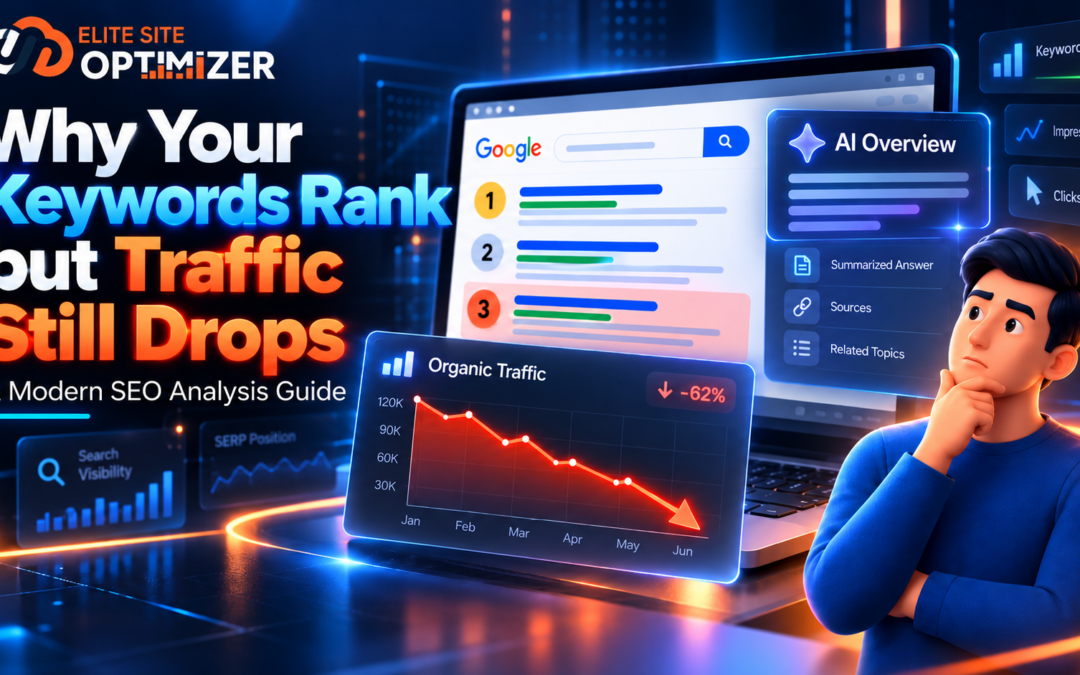
Your website is ranking on Google’s first page. Your target keywords maintain strong positions, and your SEO reports look promising.
But there’s a problem: your organic traffic keeps dropping.
Understanding the reasons behind an organic traffic drop is important for improving your website’s search performance.
If your keyword rankings are stable, shouldn’t your website traffic remain consistent?
Not necessarily.
Search engines have evolved beyond traditional keyword rankings. With AI-generated answers, featured snippets, changing search behavior, and increasing competition, ranking higher doesn’t always guarantee more visitors.
Today, a website can maintain its search positions while experiencing fewer clicks, lower engagement, and reduced conversions.
Understanding why this happens is essential for building an effective SEO strategy.
Let’s explore the reasons behind declining organic traffic and how to identify opportunities to recover lost clicks.
1. Why Keyword Rankings Don’t Always Translate into Traffic
Keyword rankings indicate where your website appears in search results, but they don’t measure how many people visit your website.
SEO Insight: Ranking High Doesn’t Always Mean More Clicks
A website can maintain its keyword rankings while losing organic traffic. AI-generated answers, featured snippets, changing search demand, and competitor listings can reduce the number of users clicking through to your website.
Key Takeaway: Monitor impressions, CTR, and organic clicks alongside keyword rankings to understand your actual search performance.
For example, your page might rank third for “website SEO audit,” but users may find the information they need directly in Google’s search results.
They might see an AI-generated answer, featured snippet, video, or competitor listing before reaching your website.
As a result, your ranking remains stable, but fewer users click.
Modern SEO success depends on three important factors:
- Visibility: How often your website appears in search results.
- Click-through rate (CTR): How frequently users click your listing.
- Search demand: How many people are searching for your target keywords.
Monitoring these factors through SEO traffic analysis helps explain why traffic may decline even when rankings remain unchanged.
2. Seven Reasons Your Keywords Rank but Traffic Drops
1. AI-Powered Search Results Reduce Click Opportunities
Google AI Overviews and other AI-powered search experiences are changing how people find information.
Users can receive detailed answers directly on the search results page without necessarily visiting a website.
For example, someone searching for “How to improve website speed” may receive an AI-generated explanation covering the essential optimization steps.
Even if your website ranks among the top results, some users may not click.
What you can do:
Create original, valuable content that offers more than a general explanation. Include practical examples, detailed insights, case studies, and actionable recommendations.
Focus on providing information users cannot easily obtain from a short search summary.
2. Your Organic Click-Through Rate Is Declining
A high ranking doesn’t guarantee clicks.
Your click-through rate measures how often users select your website after seeing it in search results.
Consider this example:
| SEO Metric | Previous Month | Current Month |
| Average Position | 3.2 | 3.1 |
| Impressions | 20,000 | 20,000 |
| Clicks | 1,600 | 1,000 |
| CTR | 8% | 5% |
Although rankings remain stable, organic clicks have dropped significantly because CTR has decreased.
This may happen due to less compelling titles, competitor listings, changing search result layouts, or AI-generated answers.
What you can do:
Review pages with high impressions but declining CTR. Improve title tags and meta descriptions by highlighting clear benefits and aligning them with search intent.
3. Search Demand Has Decreased
Sometimes, your website isn’t the problem. Search demand has simply declined.
Keyword search volumes change because of seasonal trends, customer preferences, new technologies, and market conditions.
For example, your website may maintain its ranking for a particular ecommerce keyword, but fewer people may be searching for that term.
Even strong rankings cannot generate traffic when search demand decreases.
What you can do:
Use Google Search Console and Google Trends to analyze impression trends and seasonal changes.
Identify emerging search queries and update your keyword strategy based on current audience interests.
4. Search Intent Has Changed
Search intent describes what users expect to find when searching for a keyword.
For example, someone searching for “SEO audit tool” may want an interactive tool rather than an informational article.
If Google’s results increasingly favor tools and comparison pages, your informational content may become less attractive to users.
What you can do
- Review the current search results for your important keywords.
- Understand whether users prefer guides, tools, comparisons, videos, or product pages.
- Update your content to match the searcher’s expectations.
5. SERP Features Are Taking Attention Away
Google search results now include AI Overviews, featured snippets, People Also Ask sections, local listings, videos, and advertisements.
These features compete with traditional organic results.
Your website might rank second organically but appear much farther down the visible page, especially on mobile devices.
What you can do:
Analyze how your target keywords appear on desktop and mobile.
Optimize relevant content for suitable search features through clear headings, useful visuals, structured information, and eligible schema markup.
6. You’re Losing Long-Tail Keyword Traffic
Your primary keywords may maintain their rankings while your website loses traffic from secondary and long-tail queries.
For example, your website may rank well for “technical SEO audit” but lose visibility for related searches such as:
- Technical SEO checklist for ecommerce websites
- How to identify website crawling issues
- Technical SEO problems affecting traffic
These smaller losses can collectively create a significant decline in organic traffic.
What you can do:
Analyze page-level and query-level performance in Google Search Console.
Identify declining long-tail queries and update your content to address relevant topics, questions, and information gaps.
7. Technical SEO Issues Are Affecting Performance
Sometimes, organic traffic declines because of technical website problems rather than ranking changes.
Common issues include incorrect canonical tags, indexing restrictions, broken redirects, server errors, and website rendering problems.
Analytics tracking errors can also make traffic appear lower than it actually is.
What you can do:
Perform a technical SEO audit covering indexing, crawlability, redirects, internal links, mobile usability, and analytics implementation.
Compare Google Search Console clicks with GA4 organic sessions to identify potential tracking discrepancies.
3. How to Analyze an Organic Traffic Drop
Instead of making random SEO changes, follow a structured investigation process.
Step 1: Check Google Search Console
Perform a Google Search Console analysis to compare clicks, impressions, CTR, and average keyword positions across equivalent reporting periods.
Step 2: Identify Pages Losing Traffic
Find which landing pages experienced the largest declines. Determine whether the issue affects specific pages or the entire website.
Step 3: Analyze Keyword Performance
Examine individual queries to identify ranking changes, declining impressions, and reduced click-through rates.
Step 4: Review Search Result Changes
Check whether AI-generated answers, competitor listings, or other SERP features are affecting visibility.
Step 5: Audit Website Health
Investigate technical SEO issues, outdated content, mobile performance, and indexing problems.
Step 6: Monitor Improvements
Implement targeted fixes and track changes over time to understand which optimizations improve performance.
4. Identifying Missed Click Opportunities
One of the most effective ways to improve organic traffic is to identify keywords that generate impressions but relatively few clicks.
These are potential missed click opportunities.
SEO Opportunity: High Impressions, Low Clicks
Pages receiving significant search impressions but relatively few clicks may have opportunities for improvement.
Review their average ranking positions, title tags, meta descriptions, search intent, and competing SERP features before making changes.
Key Takeaway: Improving CTR on relevant, high-impression pages can help recover organic traffic without necessarily improving keyword rankings.
For example:
| Keyword | Impressions | Clicks | CTR |
| SEO website audit | 8,000 | 400 | 5% |
| Technical SEO checklist | 6,500 | 130 | 2% |
| Website optimization tool | 5,000 | 75 | 1.5% |
The keywords with lower CTR may deserve further investigation.
However, low CTR doesn’t automatically mean poor performance. Ranking position, search intent, competition, and SERP features also influence click behavior.
By analyzing these factors together, businesses can identify opportunities to improve search visibility and attract more relevant visitors.
Platforms like Elite Site Optimizer (ESO) help SEO professionals investigate these opportunities through keyword rank tracking, missed click opportunity analysis, competitor analysis, and technical website monitoring.
Combining these insights provides a clearer understanding of where potential traffic opportunities exist.
5. How to Recover Declining Organic Traffic
Once you’ve identified the underlying problems, focus on targeted improvements to address declining organic clicks.
Optimize titles and descriptions: Create compelling, relevant search snippets that clearly communicate the value of your content.
Refresh existing content: Update outdated information, answer relevant questions, and add practical insights.
Expand keyword coverage: Target relevant long-tail queries and strengthen topic coverage through useful supporting content.
Improve technical SEO: Resolve crawlability, indexing, performance, and mobile usability issues.
Analyze competitors: Understand how competing websites attract clicks and identify opportunities to differentiate your content.
Improve AI search readiness: Publish well-structured, original, helpful content that search engines and AI-powered experiences can understand.
Prioritize improvements based on evidence rather than assuming every traffic decline requires a complete SEO strategy change.
6. SEO Metrics You Should Track Beyond Rankings
To understand actual SEO performance, businesses should monitor more than keyword positions.
| SEO Metric | Purpose |
| Organic Clicks | Measures visits generated through Google Search clicks |
| Search Impressions | Shows how frequently your pages appear in search |
| Organic CTR | Tracks how often impressions convert into clicks |
| Keyword Rankings | Monitors positions for important queries |
| Landing Page Performance | Identifies pages gaining or losing traffic |
| Missed Click Opportunities | Highlights potential areas for CTR improvement |
| Conversions | Measures business results generated through organic traffic |
Combining these metrics makes it easier to understand whether traffic changes are caused by declining search demand, visibility issues, or reduced click engagement.
Conclusion
Strong keyword rankings don’t always mean strong organic traffic.
AI-powered search experiences, changing search intent, reduced CTR, and evolving user behavior have made SEO performance more complex.
Instead of focusing only on keyword positions, businesses need to understand how visibility translates into clicks, engagement, and conversions.
By combining keyword tracking, technical SEO analysis, competitor monitoring, and missed click opportunity identification, businesses can uncover the reasons behind declining traffic and make more informed optimization decisions.
Your keywords may already be ranking. The next step is understanding why users aren’t clicking.
CTA: Discover What’s Limiting Your Organic Traffic
Identify missed click opportunities, monitor rankings, and uncover website optimization issues with Elite Site Optimizer.
Ready to improve your website’s search performance?
Sign up for Elite Site Optimizer and start analyzing your website’s SEO, accessibility, performance and content quality.
Start Your Free Signup