

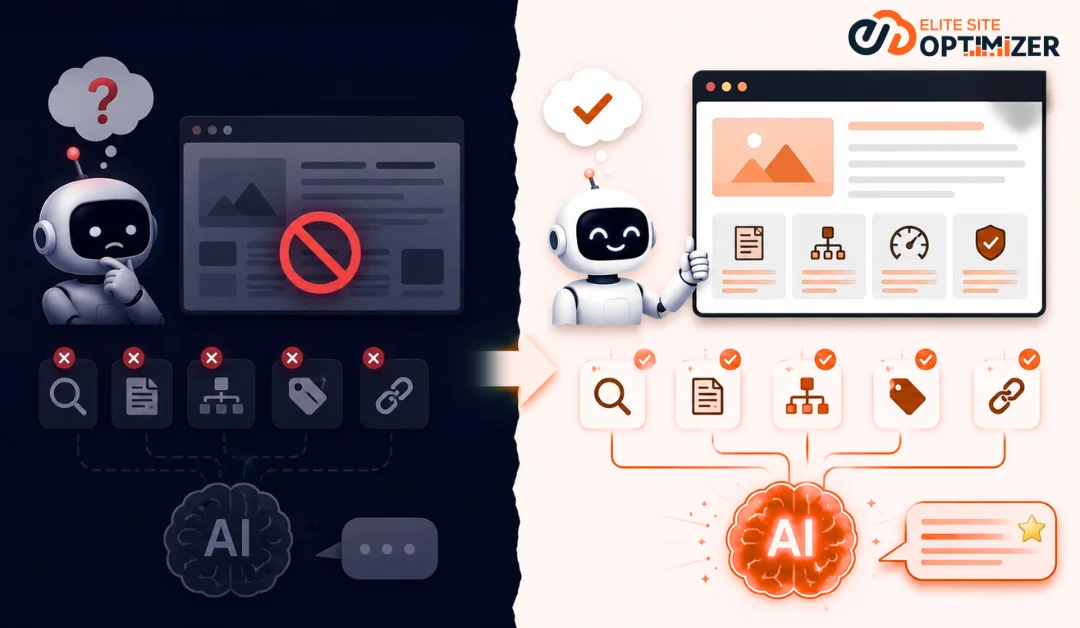
Your website may already be losing visibility in AI-generated search experiences without you realizing it.
Many businesses invest heavily in SEO, content creation, and search rankings but still fail to appear in responses generated by platforms like ChatGPT, Gemini, Claude, and Perplexity. The problem often goes beyond rankings and comes down to how AI platforms perceive your website. In many cases, AI systems simply do not view the website as clear, trustworthy, or structured enough to reference confidently.
This is becoming one of the biggest hidden visibility problems in modern digital marketing. A website can rank well in traditional search engines and remain absent from AI-generated answers because the signals AI systems rely on are very different from traditional SEO factors.
As AI-driven search becomes more influential, websites that fail to adapt risk becoming less discoverable, less referenced, and less trusted across modern digital experiences.
Why ChatGPT Doesn’t Cite My Website
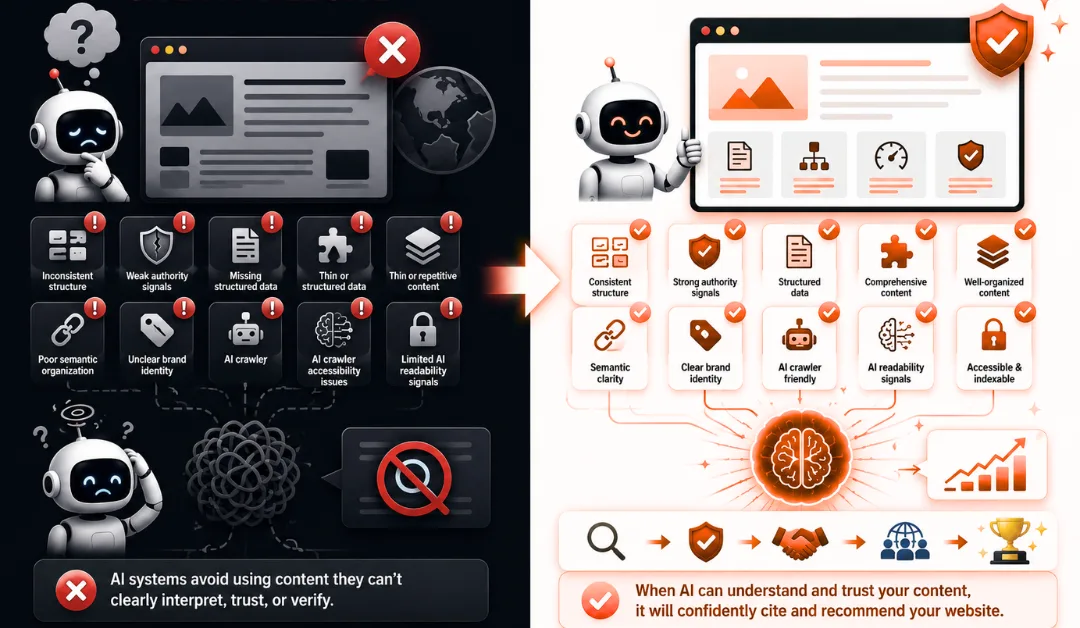
Why ChatGPT doesn’t cite your website often comes down to weak authority signals, poor semantic structure, unclear content organization, or limited AI readability.
AI platforms do not randomly select websites when generating answers. They prioritize sources that appear reliable, well-structured, and contextually complete. If your website creates uncertainty or lacks strong AI readability signals, AI systems may avoid using it even when your SEO performance appears strong.
Many websites unknowingly create barriers that weaken AI discoverability, including:
- Inconsistent content structure
- Weak authority indicators
- Missing structured data
- Thin or repetitive content
- Poor semantic organization
- Unclear brand identity
- AI crawler accessibility issues
AI-generated visibility is no longer based only on rankings. It depends on whether AI systems can confidently interpret and trust your content.
The Hidden Reasons AI Platforms Skip Your Website
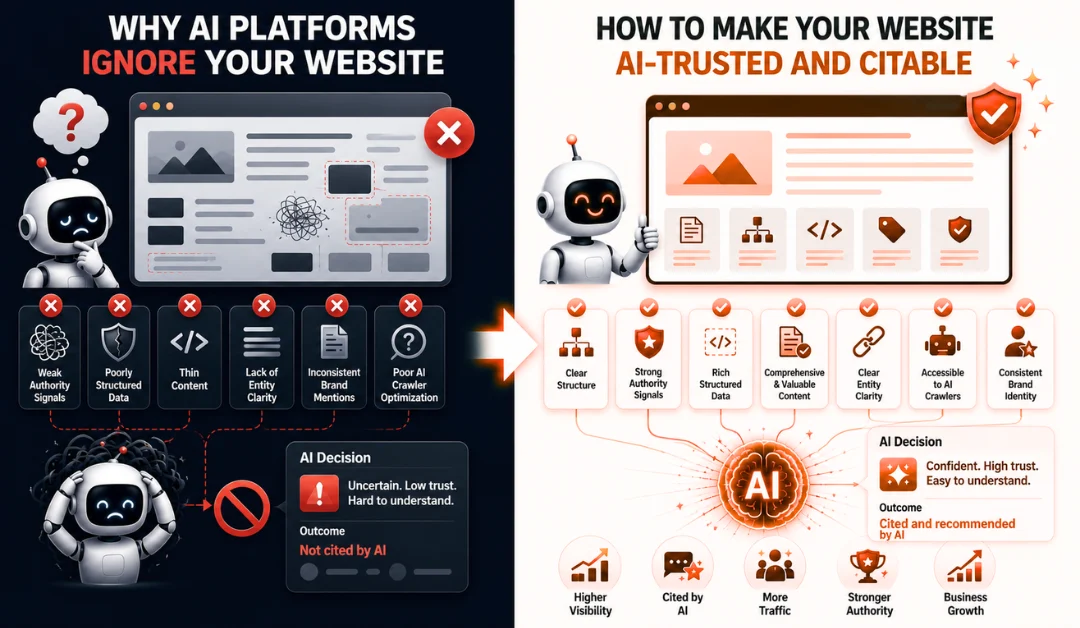
AI platforms are designed to reduce uncertainty before referencing a source. They evaluate whether the content is clear, trustworthy, relevant, and easy to extract into generated answers.
When websites create ambiguity, weak trust signals, or inconsistent context, AI systems often avoid referencing them altogether.
This means your website may already contain hidden visibility gaps that traditional SEO audits fail to identify.
The Most Common AI Search Visibility Issues
1. Weak Authority Signals Create Trust Problems
One of the biggest reasons AI platforms ignore websites is a lack of visible trust and expertise signals.
AI systems increasingly evaluate whether your website appears credible across a broader content ecosystem. If your website lacks clear expertise indicators, AI systems may hesitate to reference it even when the content itself is relevant.
Common authority issues include:
- Missing author information
- Weak E-E-A-T signals
- Limited topical depth
- Poor internal content relationships
- Thin supporting content
- Inconsistent expertise positioning
Many businesses focus heavily on publishing content but overlook whether the website actually demonstrates authority in a clear and trustworthy way.
If AI systems cannot confidently determine your expertise, your visibility decreases significantly.
2. Poorly Structured Data Weakens AI Understanding
Structured data helps AI systems understand what your content represents and how different entities relate to each other. Without it, AI platforms may struggle to interpret your website accurately.
Many websites either fail to implement schema markup correctly or provide incomplete structured data that offers limited contextual understanding. This weakens AI comprehension and reduces citation readiness.
Important schema types include:
- Organization schema
- FAQ schema
- Article schema
- Breadcrumb schema
Without strong structured data, AI systems often fail to connect your business, services, and expertise accurately.
Structured data improves AI understanding, contextual relevance, and discoverability.
3. Thin Content Signals Low Value
Many websites publish content that appears optimized for rankings but provides little original insight or contextual depth. AI systems increasingly recognize this pattern.
Thin content often includes:
- Generic explanations
- Repetitive information
- Weak topic coverage
- Minimal practical value
- Poor answer completeness
AI systems prioritize content that demonstrates clarity, depth, and meaningful expertise. Content that feels shallow or repetitive creates weaker trust signals and lower citation potential.
If your content does not provide enough depth or clarity, AI systems may consider it replaceable.
4. Lack of Entity Clarity Confuses AI Systems
AI platforms rely heavily on entity recognition to understand who your business is, what services you offer, and which topics your brand is associated with.
If your branding, messaging, and topic positioning aren’t aligned properly, AI systems will struggle to associate your website with relevant search intent. It diminishes discoverability and lowers the chances that others will cite it.
Entity clarity includes:
- Consistent brand naming
- Clear service positioning
- Topic specialization
- Structured organization data
- Consistent messaging across pages
Many websites unintentionally create mixed signals that reduce AI confidence in their business identity.
Strong entity clarity helps AI systems associate your website with the right topics and search intent.
5. Inconsistent Brand Mentions Reduce AI Confidence
AI systems evaluate information across multiple digital sources, not just your website. If your business information varies across directories, mentions, social profiles, and external references, AI systems may struggle to validate your identity consistently.
This creates uncertainty, and AI systems generally avoid citing sources that appear inconsistent or unreliable.
Inconsistencies often appear in:
- Brand descriptions
- Service categories
- Business positioning
- Contact information
- Messaging tone
Businesses that maintain stronger consistency across digital platforms create clearer trust signals for AI systems.
6. Poor AI Crawler Optimization Limits Discoverability
Many websites are optimized for traditional search crawlers but fail to consider how AI systems access and process content.
AI systems rely on crawlability and rendering accessibility to interpret website content effectively. When websites unintentionally restrict AI crawlers or create rendering complexity, discoverability decreases significantly.
Common AI crawler optimization issues include:
- Blocking AI crawlers in robots.txt
- Missing sitemap references
- Heavy JavaScript dependency
- Poor HTML readability
- Slow rendering performance
- Missing AI crawl guidance
Websites that create unnecessary crawl and rendering barriers often become difficult for AI systems to interpret reliably.
If AI systems struggle to access or process your content efficiently, they dramatically decrease your chances of being cited.
Why SEO Rankings Alone No Longer Guarantee Visibility
A growing number of businesses are discovering that high rankings alone no longer guarantee digital visibility.
AI-generated search experiences evaluate websites differently from traditional search engines. Instead of focusing only on rankings, AI systems prioritize:
- Extractability
- Semantic clarity
- Trust signals
- Topic relationships
- Content completeness
- Citation readiness
This phenomenon is why many websites with strong SEO performance still fail to appear in AI-generated answers.
A website optimized only for rankings may remain invisible in AI-driven discovery environments.
Signs AI Platforms May Be Ignoring Your Website
Many businesses do not realize they have AI visibility problems until traffic patterns and discoverability begin to decline.
Common warning signs include:
- Your website ranks well but rarely appears in AI-generated answers.
- AI-generated summaries rarely reference your brand or expertise.
- Your content receives visibility but low citation mentions
- Website content feels fragmented or inconsistent across pages
- AI crawlers struggle to access or render important content
- Your competitors appear more frequently in AI-generated responses.
These warning signs often indicate deeper structural and contextual problems affecting AI discoverability.
How to Improve AI Discoverability
Improving AI discoverability requires more than traditional optimization tactics. Businesses must reduce ambiguity and strengthen the signals AI systems rely on for interpretation and trust.
Key improvements include the following:
- Strengthening semantic structure
- Implementing structured data correctly
- Improving authority and expertise signals
- Creating answer-focused content
- Optimizing AI crawlability
AI discoverability is built through structure, trust, clarity, consistency, and contextual relevance working together.
Why Elite Site Optimizer Over Others?
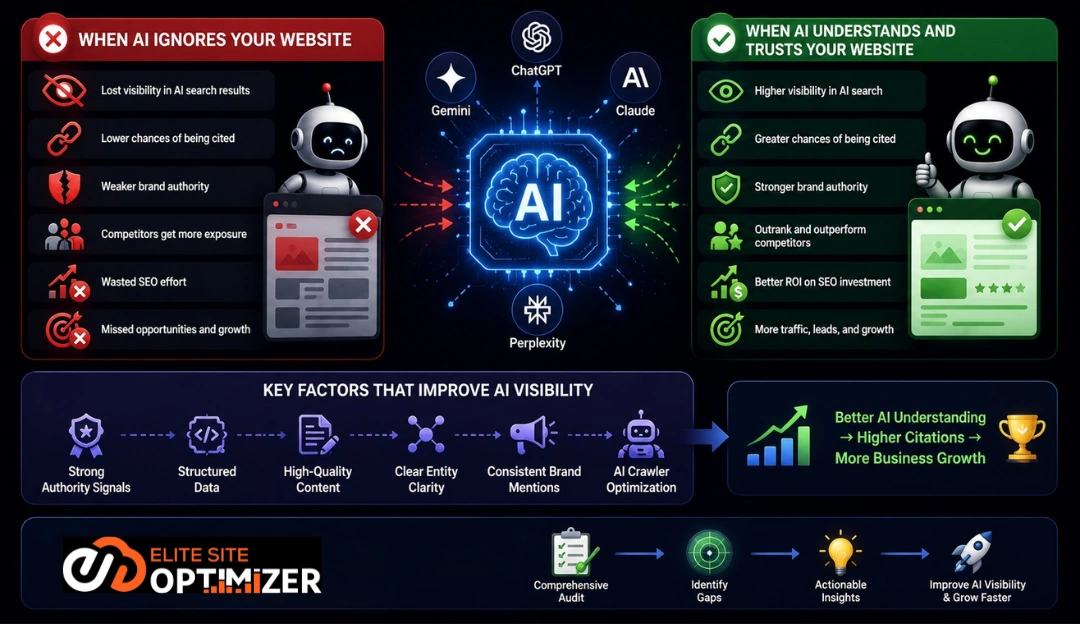
Most SEO platforms focus heavily on rankings, traffic estimates, and keyword monitoring. While those metrics remain useful, they fail to explain why AI platforms may still ignore your website.
Elite Site Optimizer is built specifically to uncover the hidden visibility gaps affecting AI discoverability and citation readiness.
What Makes Elite Site Optimizer Different
AI Readiness Audit Built for AI-Driven Search
Elite Site Optimizer evaluates whether your website is truly prepared for AI interpretation, extraction, and discoverability.
The AI Readiness Audit analyzes critical areas such as the following:
- AI crawlability
- Semantic structure
- Structured data implementation
- Content readability
- Rendering accessibility
- Authority signals
- Citation readiness
This feature helps businesses identify structural and contextual problems that traditional SEO audits often overlook.
AI Citation Visibility Insights
Elite Site Optimizer also evaluates how AI platforms perceive and reference your website through its AI Citation analysis capabilities.
This helps businesses understand:
- Whether AI systems mention their website
- How often citations occur
- Which visibility gaps reduce discoverability?
- What weakens citation readiness across AI platforms
This transforms AI optimization from assumptions into measurable AI visibility intelligence.
Actionable Recommendations Instead of Generic Metrics
Instead of focusing only on rankings and surface-level SEO metrics, Elite Site Optimizer provides actionable recommendations that improve:
- Semantic clarity
- Structured data implementation
- AI readability
- AI crawler accessibility
- Content structure
- Authority and trust signals
This framework creates a practical roadmap for improving AI discoverability and long-term visibility.
AI Readiness Scoring System
Elite Site Optimizer uses a weighted scoring framework to measure overall AI readiness across multiple categories.
This includes:
- Crawlability
- Performance
- Semantic structure
- Content quality
- Structured data
- Authority signals
The scoring system helps businesses understand how prepared their website is for AI-driven search environments.
How Elite Site Optimizer Differs from Traditional SEO Platforms
Traditional SEO tools primarily focus on rankings and indexing. Elite Site Optimizer focuses on helping websites become understandable, trustworthy, extractable, and reference-worthy for AI systems.
The platform prioritizes:
- AI discoverability instead of rankings alone
- Semantic understanding instead of keyword repetition
- Citation readiness instead of visibility metrics alone
- AI readability instead of surface-level optimization
It bridges the growing gap between traditional SEO and AI-driven search visibility.
What Businesses Stand to Lose
AI-generated search experiences are rapidly changing how users discover products, services, and businesses online. Companies that fail to improve AI discoverability may continue investing in traditional SEO while gradually losing visibility across AI-driven platforms.
This loss is often difficult to notice at first. Rankings may remain stable, but AI-generated answers may stop referencing your website, recommending your services, or recognizing your expertise. This can eventually reduce brand visibility, weaken digital authority, and limit future discoverability.
Businesses that improve AI readiness gain advantages such as the following:
- Increased visibility across AI platforms
- Higher citation potential
- Stronger authority perception
- Better content interpretation
- Improved long-term search resilience
As AI-generated discovery becomes more influential, businesses that adapt early will be in a far stronger position to maintain visibility and trust online.
FAQ: AI Search Visibility Issues
Why doesn’t ChatGPT cite my website?
ChatGPT may not cite your website if your content lacks semantic clarity, structured data, authority signals, or AI-friendly formatting.
What causes AI search visibility issues?
Common causes include poorly structured data, weak authority signals, inconsistent branding, thin content, and blocked AI crawlers.
How can I improve AI discoverability?
You can improve AI discoverability by strengthening semantic structure, implementing structured data, improving authority signals, and optimizing AI crawlability.
What is AI crawler optimization?
AI crawler optimization ensures AI systems can efficiently access, render, and interpret your website content.
Final Thoughts
The Real Risk of Ignoring AI Visibility
AI-driven search is rapidly reshaping how users discover businesses, services, and information online. Websites that fail to adapt may continue investing in SEO while quietly losing visibility across AI-generated search experiences.
The challenge is no longer just ranking in search engines. The real challenge is ensuring AI systems can clearly interpret, trust, and reference your content.
Websites with weak authority signals, poor semantic structure, inconsistent branding, and limited AI readability are far more likely to be ignored by platforms like ChatGPT, Gemini, Claude, and Perplexity.
Businesses that improve AI discoverability today will gain a stronger competitive advantage as AI-driven search continues to shape digital experiences.
If AI platforms continue to ignore your website, the issue is likely not traffic alone. The issue is AI readiness.
Explore the AI Readiness Audit from Elite Site Optimizer to uncover the structural, semantic, and visibility gaps affecting your AI discoverability and citation potential.
Ready to improve your website’s search performance?
Sign up for Elite Site Optimizer and start analyzing your website’s SEO, accessibility, performance and content quality.
Start Your Free Signup